
The Indo-Iranic Split
Zoroaster was a Blond Man


Before reading, this map of he region with place names may be useful to some readers. I understand that Central Asia is one of the most forgotten regions of the world, so if you are confused at any of the place names just refer here.
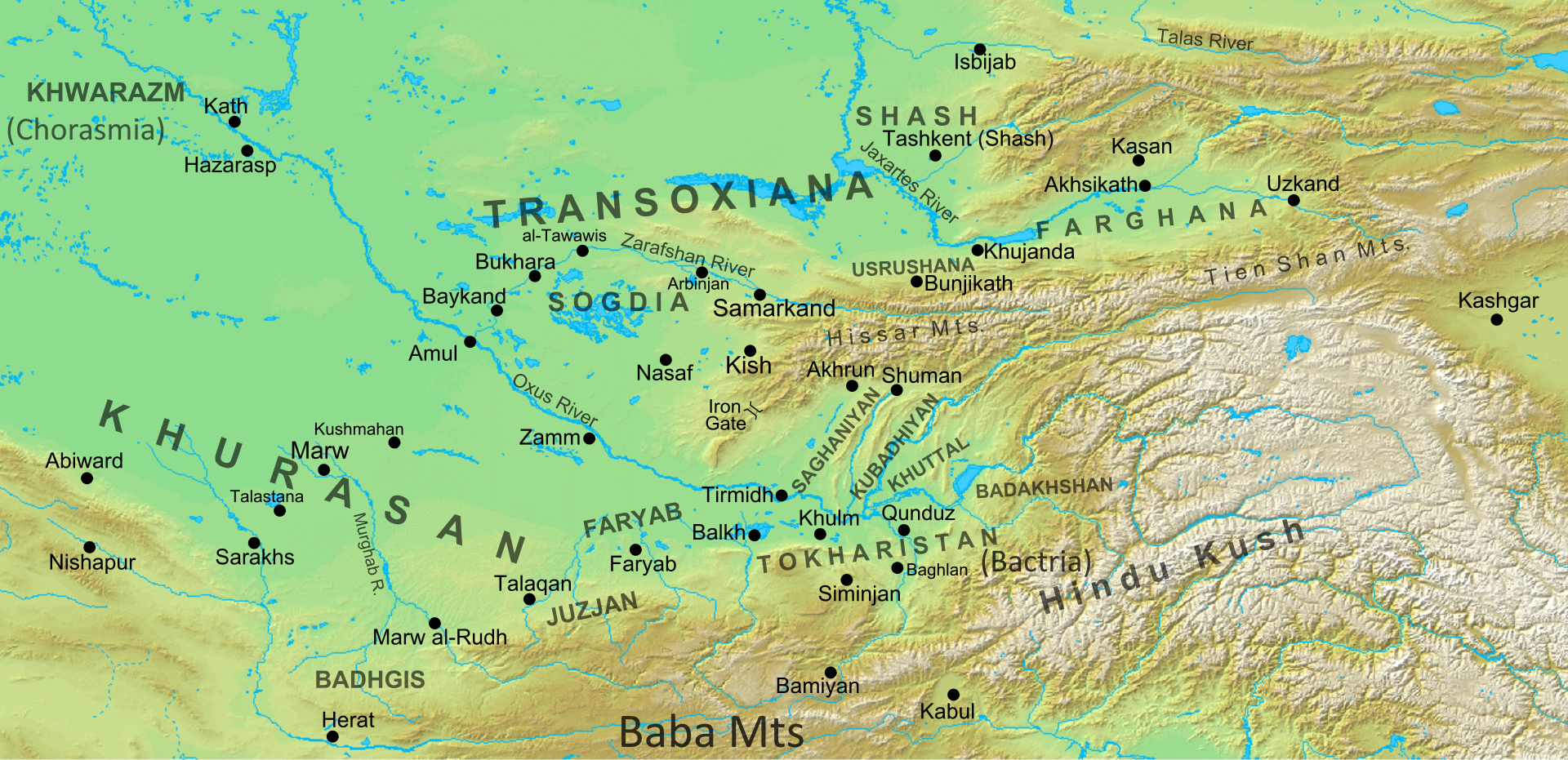
Also, I would like to provide some context. Before the coming of the Aryans, two civilizations had developed in South-Central Asia. Along the Indus River, there was the Indus Valley Civilization (IVC for short). You probably learned about this one in school, a little bit, but the second one is more niche. It is sometimes called the Oxus Civilization, but this is a poor term, as much of it was concentrated in the region we would call “Khorasan” or “Margiana” rather than along the Oxus. This region is fed by rivers from the Iranian Plateau descending into Central Asia, rather than tributaries of the Oxus. Today, it is called the Bactria-Margiana Archaeological Complex, or “BMAC”. Both groups descended mostly from Neolithic inhabitants of the Zagros Mountains, or a similar group. The former, however, has admixture from the Andamanese-like indigenes of the Indian subcontinent, while the latter had admixture from the Anatolian Farmers whose distant cousins had introduced farming to Europe. Both of these civilizations experienced catastrophic droughts shortly before the arrival of the Aryans, leading to their demise.
It is a well-known fact that the Iranian languages — Farsi, Kurdish, Pashto, Balochi, and a few others, form a clade with the Indic languages — Hindi, Urdu, Punjabi, et cetera. How they came together, and how they fell apart, however, is a much more controversial topic. There are many questions that go into this, and many questions whose answers rely on this. It determines the dating of the Vedas and the Zoroastrian Gathas, and subsequently determines the identity of both the Rigvedic tribes and the speakers of the earliest Iranic languages, namely Old Avestan. In this post I would like to elucidate you, the reader, on the life of the Proto-Indo-Iranic language, from its birth to its death.
Part 1: From Indo-European to Indo-Iranic
There isn’t any consensus on when the Indo-Iranic languages split from the other Indo-European languages, but there are some boundaries. It seems to have branched off after the branching off of Tocharian and Anatolian, but before the diversification of Western European languages like Italic, Celtic, and Germanic. The Graeco-Aryan hypothesis is well-known and flashy, but it is rarely seen anymore. Linguistic associations with Indo-Iranians, if they were ever real, probably have to do with Catacomb Culture influence on the succeeding Corded Ware derived Srubnaya Culture. The Catacomb Culture is genetically more or less identical to the Yamnaya Culture, and the final true successor to it. It would eventually meet its doom, and be overwhelmed by Corded Ware raiders, but some Catacomb lineages survived in the succeeding Srubnaya Culture and spread into Central Asia. There are archaeological similarities between the Mycenaeans and Catacomb Culture, most notably burial masks. However, the most direct evidence of Catacomb origin for Greek is the presence of Y-haplogroup R1b-Z2103 among both ancient and modern Greeks. This is the predominant paternal lineage of the Yamnaya and Catacomb cultures, and is present both in Greeks and Armenians, who are well-established to have a linguistic connection. The Indo-Iranians, on the other hand, were predominantly of R1a lineages, which aren’t present in Ancient Greece and only present in modern Greece due to the Slavic migrations. This casts a great deal of doubt on the Graeco-Aryan hypothesis.
The Indo-Baltic hypothesis is more reasonable. A recent book on Indo-Iranic and a semi-recent study on Indo-European phylogeny supported it. It goes much further than both groups being on the same side of the Centum-Satem divide. I have heard from Sanskritists that reconstructed Proto-Baltic looks a lot like Sanskrit, but this probably has more to do with the remarkable conservatism of the Baltic languages than with the phylogeny. If the Indo-Baltic Hypothesis is true, it is likely that it goes like this:
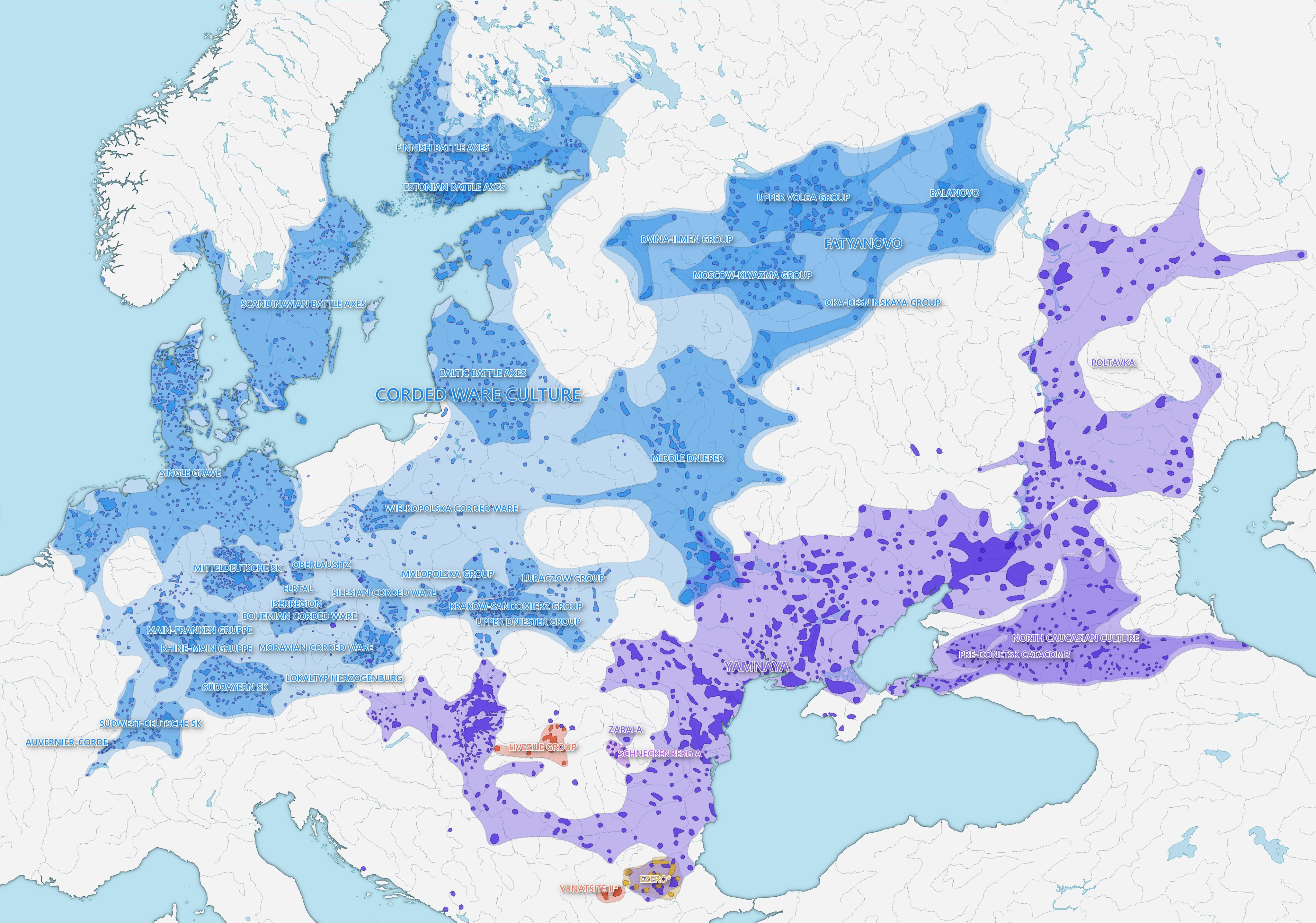
Corded Ware expands northwards, fleeing Z2103 Yamnayans. Germano-Italo-Celts invade Central Europe
Indo-Baltics live on Forest-Steppe, split apart as R1a-Z93 Indo-Iranics move eastward, forming Fatyanovo. Those who stay form Middle Dnieper Culture, which is presumably Balto-Slavic.
Indo-Iranics (through Srubnaya) push Proto-Balto-Slavs northward, where they mingle with Baltic Hunter Gatherers.
If not true, then it just means it went the other way. Fatyanovo splits off first, then Western branches split apart. I don’t really have an opinion on it and don’t think it’s terribly relevant, maybe it could invigorate some Russian Scythianists if true. The biggest piece of evidence (outside of linguistics) that it isn’t true, in my opinion, is the fact that both Slavic and Germanic R1a branches belong to the same clade outside of the Indo-Iranian clade (Z93-derived). However, R1a in Germanics is not necessarily Germanic in origin. It derives from the Battle Axe Culture, a northern variant of the Corded Ware Culture which populated Fennoscandia. They would be usurped by more Bell Beaker influenced southern groups and by Baltic invaders, bringing the modern R1b-U106 and I1 that so many Germanics have these days. It is possible the Battle Axers didn’t even speak Germanic. I would recommend Peter Nimitz’s article on Germania for the full story:

The strongest non-linguistic evidence in favor of Indo-Baltic, in my opinion, is that early Corded Ware individuals we have sampled were already in Czechia. There’s no real evidence that there was a unified phase of the Corded Ware Culture on the forest-steppe, and in my opinion the Corded Ware Culture actually began in Bessarabia. It would simply make more sense geographically and temporally, in this case, for Fatyanovo and Middle Dnieper to originate from the same northeastern movement that doesn’t include Westerners.
Map for reference:
Part 2: From Proto-Indo-Iranian to Indo-Iranian
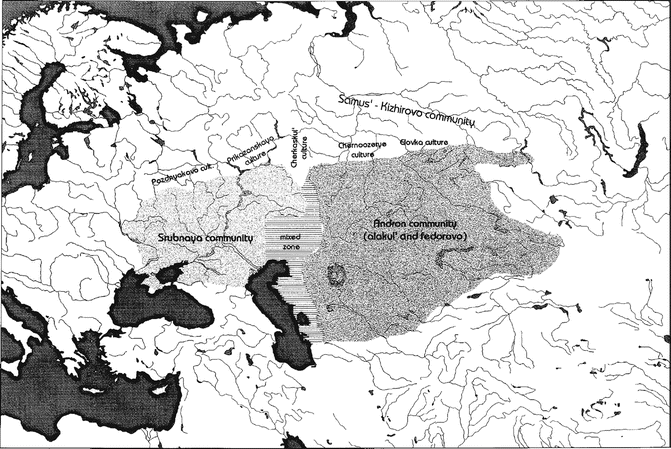
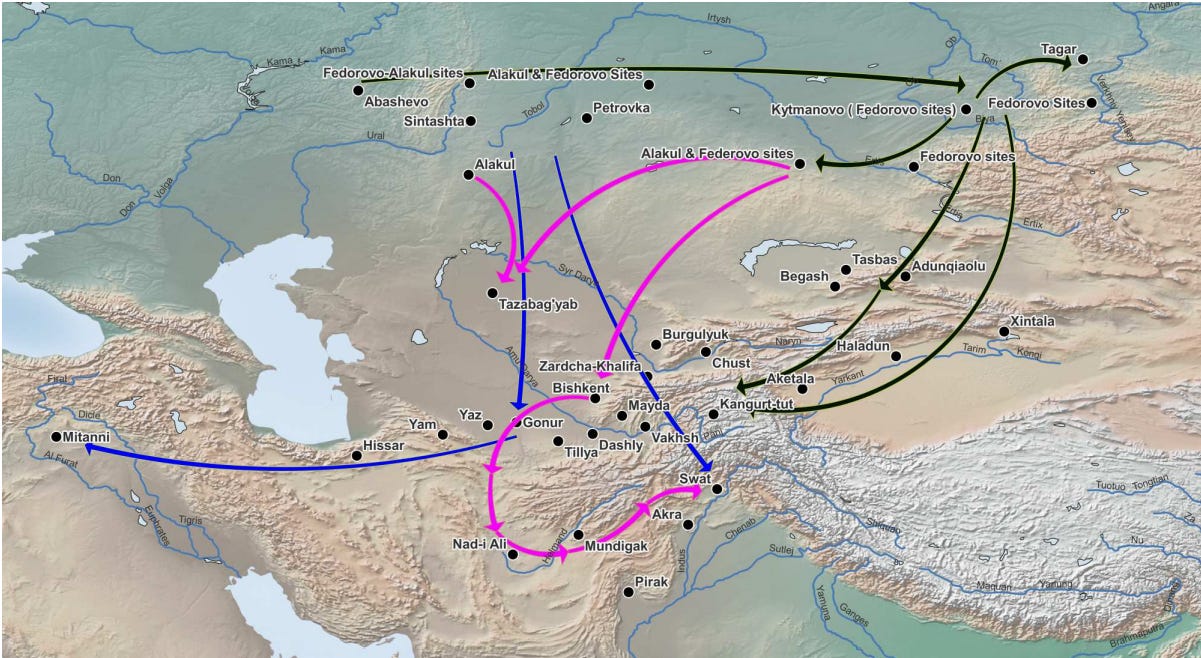
When you hear about Proto-Indo-Iranics, you probably hear less about the Fatyanovo Culture and more about the Sintashta and Andronovo Cultures. Despite the two often being treated as synonymous, the Sintashta Culture and Andronovo Culture probably have more of an avuncular relationship than a direct one. There were probably some Sintashta individuals involved in the migrations, as evidenced by Sintashta presence in the Oxus Basin, but they were quickly followed by Andronovo settlers. The earliest phase of Andronovo (Alakul) was seen as Srubnaya-adjacent and probably stems directly from the earlier Abashevo Culture west of the Ural Mountains. There is even some presence of the Srubnaya Culture itself east of the Caspian.
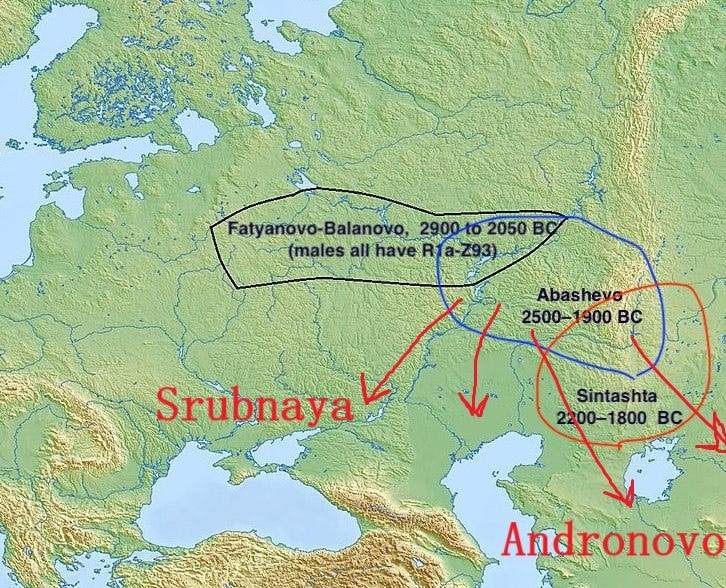
The steppes became cooler and drier during the late 3rd millennium BC, forcing the pastoral Sintashtans to quite literally search for greener pastures. At this time, the Proto-Indo-Iranians had among the greatest warriors on earth. They had invented the Chariot, a weapon which would define the next 1000 years of warfare. They may have also invented the composite bow, or at least been early adopters of it, but this is a much more speculative claim. In their trek southwards, a green light did catch their eyes. The variety of Green they found, however, was not that slightly yellowish hue typical of rolling grassy hills, but something paler and bluer. Mountains, splotched with Copper ore and Aquamarine, and walled cities that could provide markets for them. Even more valuable were the deposits of Tin and Lapis Lazuli, which found their way into the furnaces of Akkad. Their distant cousins in Britain and France were running the same operation at this time, supplying the Anatolians with tin from the West.
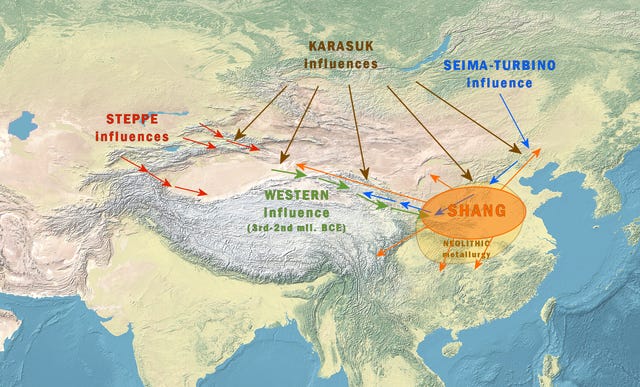
The migration southward was fast. We know that by the late 16th century BC, the Indic and Iranic languages had diverged, as it is around this time that we get the first historical records of the Mitanni (who were an Indo-Aryan ruling elite of the Hurrians in modern-day Northern Syria). On the eastern frontier of the Andronovo Culture, the Karasuk Culture forms north of modern-day Mongolia, which I think is clearly Proto-Scythian. It is a Siberianized, highly mobile branch of the Andronovo Horizon that has the Siberian ancestry that all later Scythian cultures have to some extent (and it can be used to model other Scythian-Saka cultures quite well). It was quickly followed by the genetically more or less identical Mezhovskaya Culture in Northwestern Kazakhstan and Russia, and then by the Cimmerians in Southern Russia and Ukraine (who also have Siberian ancestry, but little to no ancestry from Southern Central Asia). It would develop into the Scythian Tagar Culture, and the earliest proper Scythian burial was found in the Karasuk-Tagar area during the intermediate phase between these periods. The Karasuk Culture was heavily influenced by the mostly Uralic Seima-Turbino Phenomenon, a metallurgical horizon which stretched from the Baltic to the Altai Mountains, and may have gotten its Siberian ancestry from its interactions with Seima-Turbino groups. Seima-Turbino samples also have ancestry from early Indo-Iranians, which is hardly shocking given the fair features of many Finnic peoples of Russia today.
Linguistic evidence also shows that early Indo-Iranic people interacted quite heavily with the Uralic peoples directly north of them, and not always in a good way. The Finnic term for “Slave”, Orja, may be a corruption of the famous Iranic ethnonym “Arya”. Both groups contributed heavily to the spread of bronze metallurgy across Eurasia, most importantly in China, where they also introduced the Chariot.
Part 3: The Proto-Aryans and Proto-Iranics
Linguistic diversification has just as much to do with space as it does with time. The Germanic languages, for example, did not diversify until their expansion eastwards during the Roman Republic. In my opinion, the Indo-Iranic split is the linguistic equivalent of the Alakul-Federovo divide in the Andronovo Culture. Srubnaya-Alakul corresponds to the earlier wave of Andronovo-like settlements, which manifested southwards in the Tazabagyab Culture. The later and more eastern wave, the Federovo Culture, would represent the early Iranians. These early Iranians would split into the previously discussed Karasuk Proto-Scythians in the north, and the Chust-Yaz Proto-Avestans in the South.
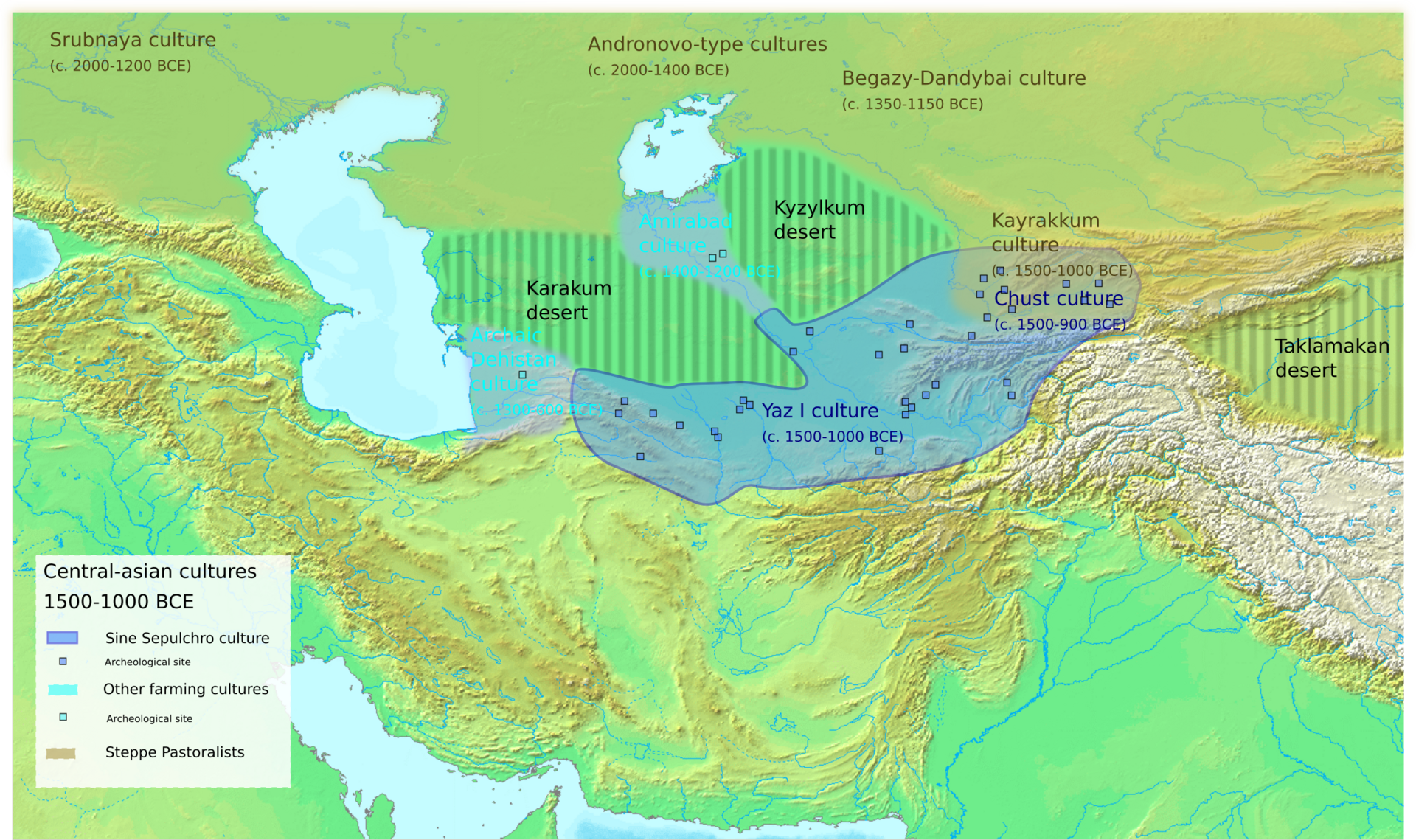
The Tazabagyab Culture looks at first to be a good candidate for early Avestans, because it is a more agrarian and sedentary branch of Andronovo. However, it’s just too early. It was already formed by the early second millennium BC. Agrarianism is also hardly a trait specific to the Iranians. It is described frequently in the Vedas. Both the Vedic and Avestan peoples were clearly practicing a mixture of sedentary farming and pastoralism.
Instead, I think the early Iranians were somewhere in the Inner Asian Mountain Corridor, the less arid region of central Asia on the foothills of the Tian Shan Mountains which separate China from the ‘stans. Eventually, as the Karasuk-derived Scythians expanded westwards, these Iranians were forced south. They established themselves in the Fergana Valley around 1500 BC, and then they expanded southwards into the Oxus Valley. If Zoroaster existed, which I think he did, I believe he would have lived among these people. Today, we call it the Yaz Culture, or the Chust Culture in the case of those settlements in Fergana. Chust Culture samples retained an Andronovo-like genetic profile well into the late Bronze Age, and the same is true for the Iranians living around the Tian Shan Mountains. I’m sure some BMAC practices influenced Zoroastrian religion, but there are much more connections to be made with the rituals and beliefs of other Indo-European religions. The homeland of Zoroaster and the Iranian peoples in general, Airyanem Vaejah, is described as a cold and wintry place, and Transoxiana remained a religiously important area for the Zoroastrian priesthood into recorded history, so I think the Chust Culture or maybe even something further north is the most likely location for Zoroaster’s home.
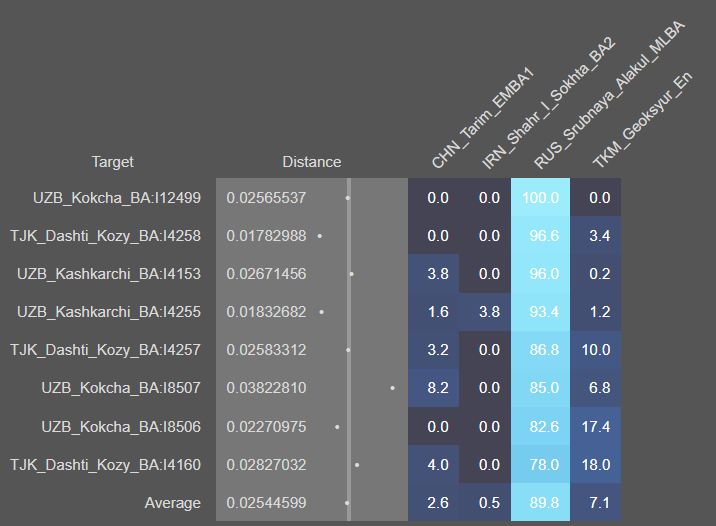
The three most southerly Andronovo samples we have today are the Kokcha samples from near the Oxus river (archaeologically associated with the Tazabagyab culture), the Dashtiqozy samples from Northwestern Tajikistan, and the Kashkarchi samples from Ferghana (which, by the way, are dated to 1100 BC, which is very late for Andronovo) and likely correspond to the Chust subculture of the Andronovo Culture.
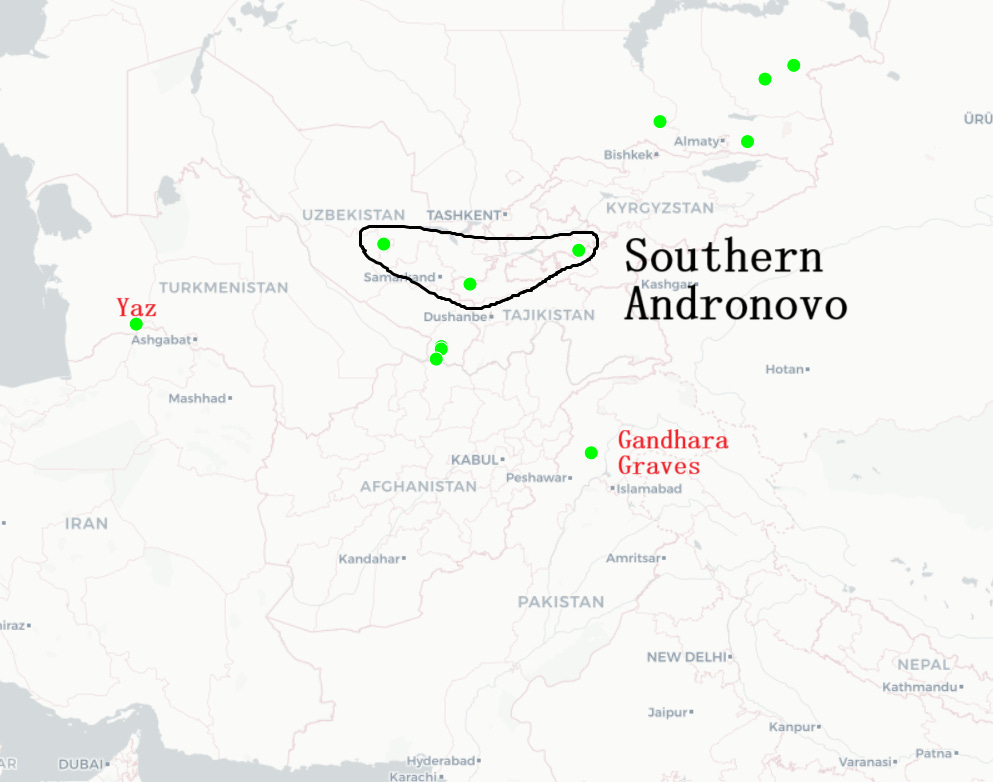
These samples are, for the most part, 80-100% MLBA Steppe on G25, but I knew of a qpadm run which modeled one of the Dashti Kozy samples as only around 70% Steppe, so I did some qpAdm runs as well. Indeed, Dashti Kozy is lower in qpAdm, but around 80% Steppe on average (likely lagged down by I4160, the 70% sample I saw and the lowest sample in G25), 14% BMAC, and 6% West Siberian Hunter Gatherer (Tarim Mummy or Botai are examples of this ancestral component) while the Kashkarchi (AKA Ferghana) samples are around 94% Steppe and 6% BMAC. Technically, modeling Kashkarchi as completely Steppe is still reasonable, but the three-way had a better p-value (in qpAdm, a higher p-value is actually better because the model is actually the null hypothesis). The Kokcha samples did not require anything other than MLBA Steppe to pass, and when other populations were included it was modeled as 98+% MLBA Steppe. The non-steppe components had too small of a Z-score to be very significant. You can see the full tibble for these at the very bottom of this post.
If those samples from Ferghana are Avestans, and samples from Karasuk are Proto-Scythians, then the samples from Kokcha are likely early Indo-Aryans in my opinion. A few months ago, an Indian scientist threatened to sue a Twitter user who I will not name because he posted an unreleased, likely never-to-be-released sample from the Sinauli site of the Indus Valley Civilization. It was quite similar looking to some of the Southern Andronovo samples, 82% Steppe and 18% BMAC. I don’t believe it was an actual Indo-Aryan invader, I think it’s more likely it was a tourist or something. It’s probably not high-quality as there is a large standard error, but it shouldn’t have been hidden.
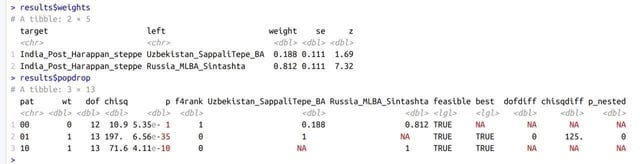
It is still possible that this is representative of the early Vedic invaders. The amount of BMAC and West Siberian HG in the early Indo-Aryans could not have been too large, as modern Indians do not need to be modeled with anything BMAC or WSHG (this doesn’t mean there isn’t some BMAC). Whether Indo-Aryan split off within the Andronovo Culture or as a sort of early breakaway from it is hard to say, because there isn’t one archaeological culture that is clearly representative of the Indo-Aryan invaders. The historical presence of Indo-Aryans outside of India is limited to the Mitanni Aryans, and according to some people, the Wusun of Western China. The closest thing we have is the Gandhara Graves Culture in the Swat Valley. It may have been Indo-Aryan, but it does not represent the core Early Vedic population. It encompasses only a small portion of the Aryavarta, it has too low Steppe and too high IVC to represent the source of Steppe ancestry in later Indian populations, and there is a lack of R1a relative to autosomal Steppe ancestry compared to modern Indians. The modern Dardic people who inhabit the area are very rich in R1a, and although they are among the most similar to Swat Valley samples, they have more Steppe ancestry than all but the outliers. There is an outlier from BMAC, near the Afghan-Uzbek border, who is genetically very similar to Swat Valley samples and predates any of the Swat Valley samples by a few centuries. In my opinion, the Gandhara Graves (Swat) samples represent a southern extension of the late Vakhsh Culture in Bactria, or some sort of successor of it. David Anthony supported the position of Tazabagyab presence in Vakhsh sites two decades ago, in his famous book The Horse, the Wheel, and the Language, before we even had any genes of the Andronovo Culture. He writes:
“About 1800 BCE the walled BMAC centers decreased sharply in size, each oasis developed its own types of pottery and other objects, and Andronovo-Tazabagyab pottery appeared widely in the Bactrian and Margian countryside. Fred Hiebert termed this the post-BMAC period to emphasize the scale of the change, although occupation continued at many BMAC strongholds and Namazga Vl-style pottery still was made inside them. But Andronovo-Tazabagyab coarse incised pottery occurred both within post-BMAC fortifications and in occasional pastoral camps located outside the mudbrick walls. Italian survey teams exposed a small Andronovo-Tazabagyab dug-out house southeast of the post-BMAC walled fortress at Takhirbai 3, and American excavations found a similar occupation outside the walls of a partly abandoned Gonur.
In the highlands above the Bactrian oases in modern Tajikistan, kurgan cemeteries of the Vaksh and Bishkent type appeared with pottery that mixed elements of the late BMAC and Andronovo-Tazabagyab traditions. Between about 1800 and 1600 BCE, control over the trade in minerals (copper, tin, turquoise) and pastoral products (horses, dairy, leather) gave the Andronovo-Tazabagyab pastoralists great economic power in the old BMAC oasis towns and strongholds, and chariot warfare gave them military control. Social, political, and even military integration probably followed […] The Mitanni dynasts came from the same ethnolinguistic population as the more famous Old Indic-speakers who simultaneously pushed eastward into the Punjab, where, according to many Vedic scholars, the Rig Veda was compiled about 1500-1300 BCE. Both groups probably originated in the hybrid cultures of the Andronovo/ Tazabagyab/ coarse-incised-ware type in Bactria and Margiana.”
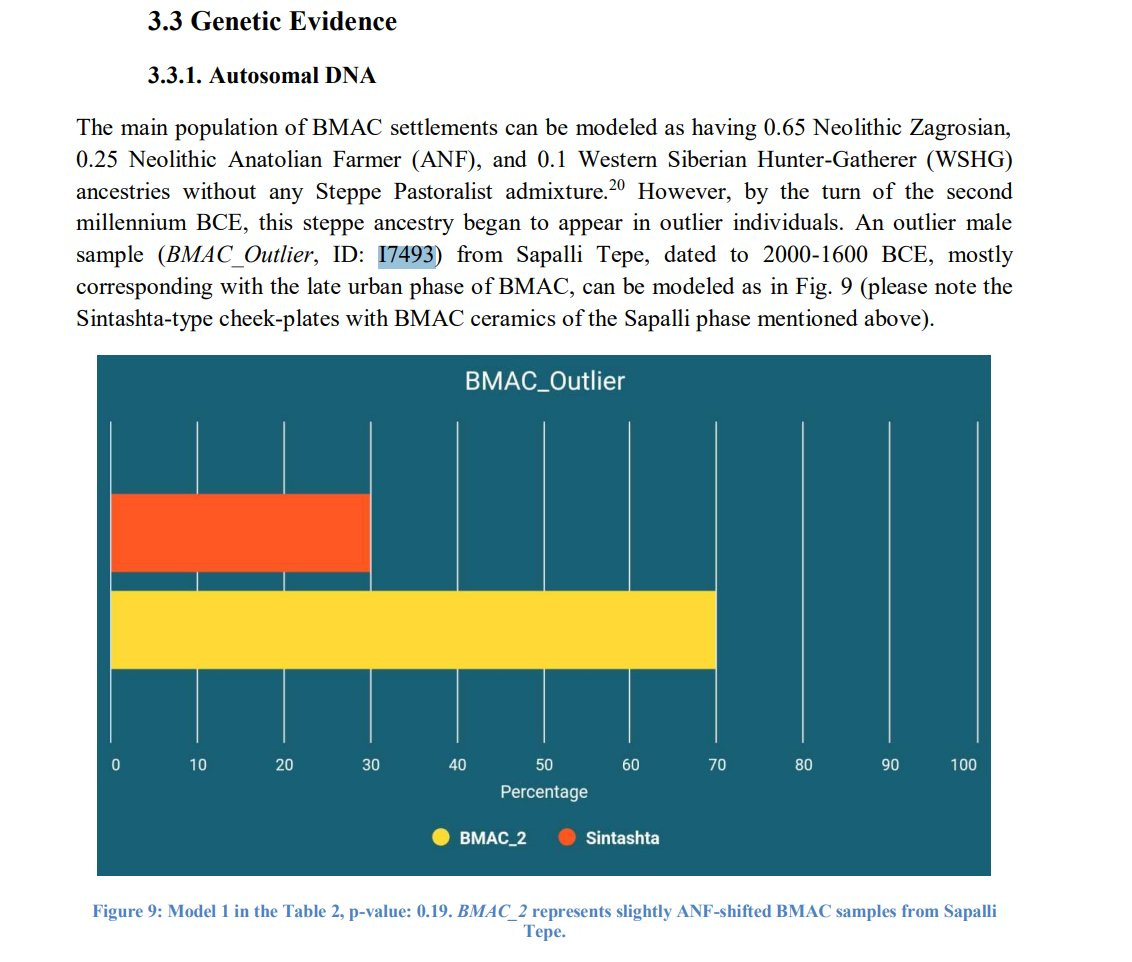
Not everyone agrees on the extent of Andronovo influence in Vakhsh sites, but they were certainly in the area. There is an outlier from Sappali Tepe (a bit west of the Vakhsh sites) that is around 30% Andronovo, 70% BMAC, and metal artifacts of Sappali Tepe become increasingly Andronovo-like during the early 2nd millennium BC.
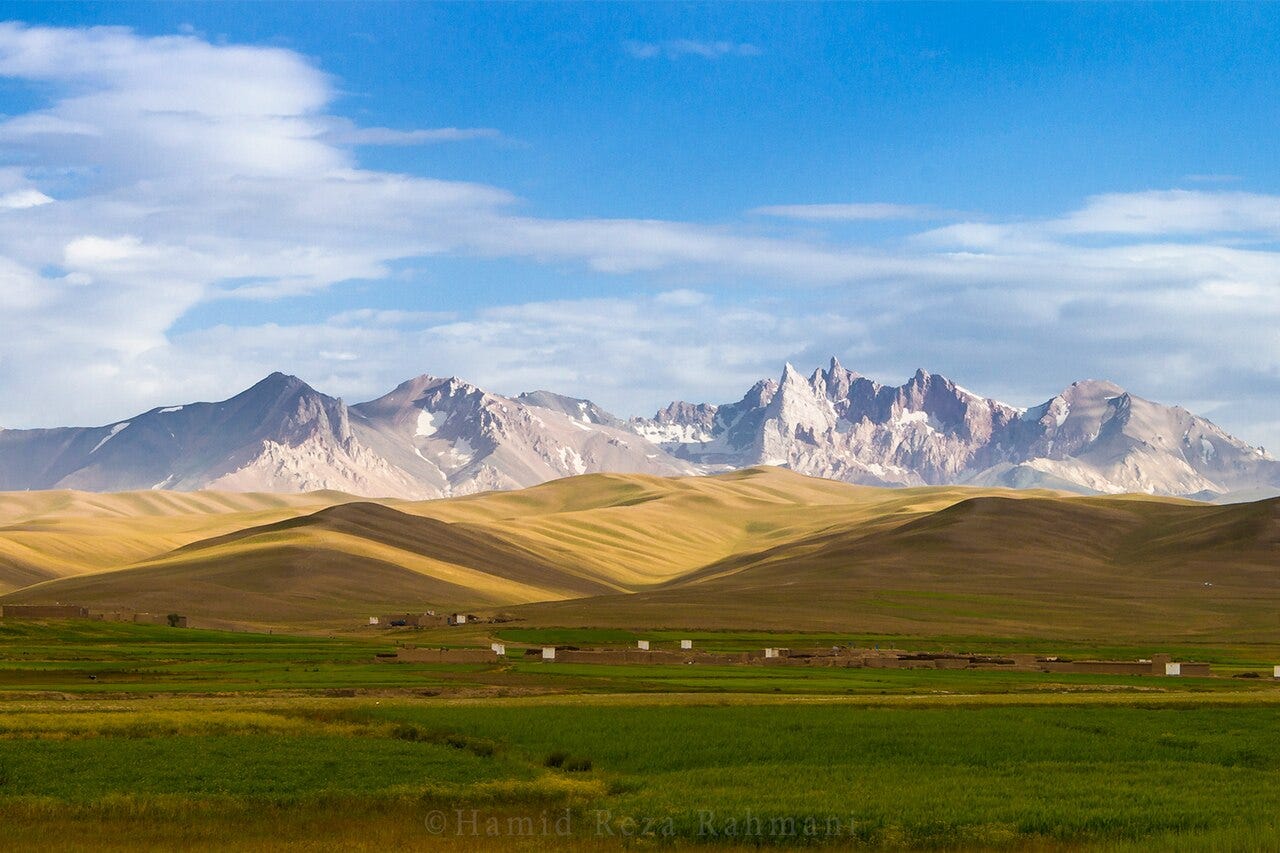
When invading Iranic groups pushed the Vakhsh Culture across the Khyber Pass, the bulk of the Indo-Aryans would have been pushed southwards into Afghanistan, pasturing their cattle on the great expanses of grassland in between the Baba Mountains and around the upper parts of Afghanistan’s montane rivers. The Hazara populate most of this region today, who themselves are famously derived from waves of Turco-Mongol steppe invaders.
By the Classical Period the Swat Valley and the surrounding area had been thoroughly Indicized (or Dardicized) and spoke the Dardic Gandhari language. This is reflected in a decrease in IVC ancestry and an increase in Andamanese-like and Steppe ancestry over the sampled time period. I’ve seen mixed evidence on the presence of BMAC in Swat Valley samples. You can model them as BMAC + IVC + Steppe, but according to the Narasimhan study they can be modeled fine as Steppe + IVC alone. It may just be that BMAC adjusts for high Andamanese-like ancestry in some of the IVC samples. They are clearly pulled either towards Iran-rich IVC or towards BMAC. It is also possible that the BMAC-like inhabitants of pre-Indo-Aryan Bactria were more IVC-like and less Anatolian as a result of their more eastern location and their proximity to the Indus Valley colony of Shortugai north of the Khyber Pass, in which case it would not be necessary to imagine all IVC-like ancestry in Swat samples as originating from the subcontinent. We would then require a third unsampled source of Neolithic Iranian ancestry to accurately model the Swat samples. The main migration of Indo-Aryans into the Punjab and later the Ganges would arrive not from directly northwards, but from the aforementioned Afghan Vedic population. I have discussed this before in my post on India, but there is a popular controversy over the location of the Saraswati river of Indian legend. Most Indians agree that it corresponds to the Ghaggar-Hakra, a river which mostly dried up by the end of the Indus Valley Civilization. Early on, it had flowed all the way to the Indian Ocean. By the later third millennium BC, it had become a seasonal river which ended in the Thar Desert. Its drying up likely contributed to the decline of the Indus Valley Civilization, which had many sites around dried up sections of the river. For this reason, deniers of the Steppe Hypothesis argue that a Vedic entrance of the subcontinent after 2000 BC would be impossible. The solution proposed by the Steppe crowd is the Haraxvaiti river in Afghanistan, which is either the Helmand or its tributary the Arghandab. It is cognate with the Saraswati, which is the strongest piece of evidence that they are the same river. Both the Haraxvaiti and the Ghaggar only share some traits with the Saraswati, which has led to the theory of two Saraswatis as proposed originally by Rajesh Kocchar. In this theory, the Saraswati of the Rig Veda, or at least the Rigvedic Family Books (Books 2 through 7), is in Afghanistan, and is some river that drains into the wetlands around Lake Hamun in southwestern Afghanistan. Then, for the later sections of the Rig Veda and the other Vedas, it refers to the weaker Ghaggar river. In post-Vedic texts it is described as going under the earth in the Thar Desert, as a disappearing or invisible river, or entirely dried up.
This lines up well with the theory of the Indo-Aryan languages as originating on the Oxus, and being pushed southwards by the Iranic tribes, who would have been encroaching from the northeast. If I had to guess, the Mitanni were likely never an ethnic group or a “folk”, but some sort of roving army or mercenary group that ended up conquering a Hurrian country after arriving in the region on business. Many such cases! However, there is some evidence of early Para-Andronovo influence in the Plateau1. This could be a Mitanni signature, or it could just be due to trade.
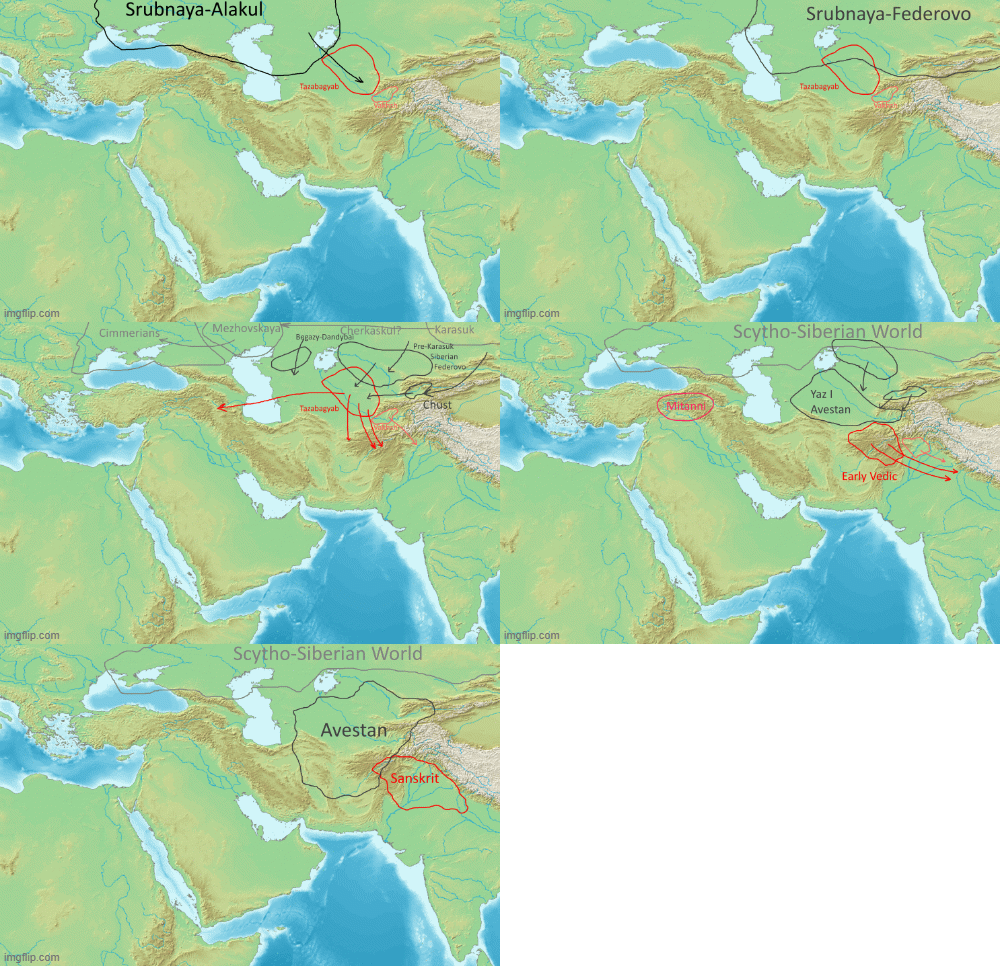
I would be remiss not to bring up the popular theory that the split between Iranians and Indic speakers was not due to geography, but due to a sort of religious schism. In Hinduism, the title of Deva is used to refer to the gods, and Asura is used to refer to demons, while in Zoroastrianism the title of Daeva is used to refer to demons while the title Ahura is given to certain gods, particularly Ahura Mazda. There are many differences between Zoroastrianism and Hinduism that one probably wouldn’t expect from peoples with such recent common heritage. Several important Vedic deities are not preserved among the Iranian Yazatas, and in Younger Avestan texts are referred to as Daevas. One of the major exceptions is Mithra, who is referred to as an Asura in Vedic texts.
I used to believe in this theory, but once you peel back the layers the problems begin to emerge. First of all, Zoroastrianism isn’t a pan-Iranic religion. Although you begin to see some elements of it among the Sarmatians and Alans, it doesn’t appear to be anything like the Scythian religion as recorded by the Greeks. Secondly, the term “Asura” and “Ahura” just mean “Lord”. All gods are technically also Asuras, but not all Asuras are gods. Early Vedic texts did not treat Asura as analogous to a necessarily evil or demonic entity. Likewise, the term “Daeva” was originally more neutral and over time became very negative and equivalent to what we would call a demon. Many gods in the Vedic pantheon are also Yazatas in the Zoroastrian texts, and despite Mitra’s Asuric title in the Vedas he is still worshipped as a god. Indra actually is seemingly represented in the Zoroastrian pantheon, but only his epithet Vrtrahan (Slaver of Vritra) survives (as Verethragna).
The identification of Vedic deities with demons was probably a reaction to rising tensions between the Indo-Aryan and Iranic peoples, rather than an in-built feature of Zoroastrianism. The Punjab is referred to in Younger Avestan texts as a land of Daeva-worshippers, “too hot for reason”. Meanwhile, Classical Indians characterize the Iranic tribes as unclean, warlike, meat-eating, impious, inbred barbarians. Most of the peoples labeled “Mleccha” were Iranic tribes. Persian suppression of Dharmic religion probably began in the Achaemenid period, but is most well-recorded during Sassanid rule. At this point, much of the East Iranic world had converted to Buddhism or Hinduism, so Dharmic adherence became a much more pressing issue for the Zoroastrians. I don’t think early Zoroastrianism in essence is particularly different from the other Indo-European religions, but if a true religious distinction existed that could have resulted in the divide, it would probably be the different characterizations of deities in India and Iran.
To the Hindus, the gods were in some sense mortal just like humans. They died and were reborn at the end of every universal cycle. They lost even more prestige in Buddhism, where they are characterized only as powerful spirits that aren’t integral to the structure of the universe. The Bodhisattvas were far superior to them in power, and more worthy of worship. This wasn’t what all Buddhists believed, some believed that the gods were simultaneously Boddhisattvas such as the Japanese. To the Iranians, the gods are immortal and existed before the creation of the universe, but are still contingent on Ahura Mazda. This would explain why Zoroaster identifies the Daeva with “beings ignorant of the distinction between truth and falsehood”, because they are capable of dying. But, I’m just playing devil’s advocate and don’t believe in the significance of the Ahura-Asura distinction.
It wouldn’t be a post on Indo-Iranic without the mention of Soma-Haoma, the mysterious invigorating substance which both Indo-Aryan and Iranic warriors apparently couldn’t get enough of. In my opinion, there are only two real candidates. The first is Ephedra, which acts as both a stimulant and a thermogenic agent. It would energize a warrior in battle, but it might also save you from freezing to death in the mountains or the arid midnights. It has been used in modernity as a PED. It was still being used as the standin for Haoma by Zoroastrians in recent history. The second possibility, I think, is some species of sugarcane, which was juiced to make Soma. There is no literal high, it just tastes good and gives your body a source of fast-acting carbohydrates. The description of Soma as “golden” also matches the color of sugarcane juice, which ranges from yellow to a lime green sort of color. The most popular species of sugarcane for agriculture are mostly found in eastern India, but some species exist in Western India, Afghanistan, and Iran.
Kokcha BA:
# A tibble: 7 × 14
  pat      wt   dof   chisq         p f4rank Russia_Srubnaya China_Xinjiang_Xiaohe_BA Turkmenistan_Gonur_B…¹ feasible best
  <chr> <dbl> <dbl>   <dbl>     <dbl>  <dbl>           <dbl>                    <dbl>                  <dbl> <lgl>    <lgl>
1 000       0    10    3.68 9.61e-  1      2           0.984                  0.00391                0.0122  TRUE     NA
2 001       1    11    7.24 7.79e-  1      1           0.998                  0.00248               NA       TRUE     TRUE
3 010       1    11    6.01 8.73e-  1      1           0.995                 NA                      0.00529 TRUE     TRUE
4 100       1    11  653.   6.81e-133      1          NA                      0.168                  0.832   TRUE     TRUE
5 011       2    12    8.45 7.49e-  1      0           1                     NA                     NA       TRUE     NA
6 101       2    12 1893.   0              0          NA                      1                     NA       TRUE     NA
7 110       2    12  774.   5.00e-158      0          NA                     NA                      1       TRUE     NA

Ferghana BA:
# A tibble: 7 × 14
  pat      wt   dof   chisq         p f4rank Russia_Srubnaya China_Xinjiang_Xiaohe_BA Turkmenistan_Gonur_B…¹ feasible best
  <chr> <dbl> <dbl>   <dbl>     <dbl>  <dbl>           <dbl>                    <dbl>                  <dbl> <lgl>    <lgl>
1 000       0    10    6.13 8.04e-  1      2           0.942                 0.000469                 0.0572 TRUE     NA
2 001       1    11   15.7  1.54e-  1      1           1.01                 -0.00645                 NA      FALSE    TRUE
3 010       1    11   11.6  3.98e-  1      1           0.946                NA                        0.0536 TRUE     TRUE
4 100       1    11  570.   4.14e-115      1          NA                     0.154                    0.846  TRUE     TRUE
5 011       2    12   19.7  7.36e-  2      0           1                    NA                       NA      TRUE     NA
6 101       2    12 1914.   0              0          NA                     1                       NA      TRUE     NA
7 110       2    12  695.   5.82e-141      0          NA                    NA                        1      TRUE     NA

Dashtiqozi BA:
# A tibble: 7 × 14
  pat      wt   dof   chisq         p f4rank Russia_Srubnaya China_Xinjiang_Xiaohe_BA Turkmenistan_Gonur_B…¹ feasible best
  <chr> <dbl> <dbl>   <dbl>     <dbl>  <dbl>           <dbl>                    <dbl>                  <dbl> <lgl>    <lgl>
1 000       0    10    4.82 9.03e-  1      2           0.795                   0.0592                  0.145 TRUE     NA
2 001       1    11   27.8  3.42e-  3      1           0.953                   0.0469                 NA     TRUE     TRUE
3 010       1    11   19.0  6.19e-  2      1           0.868                  NA                       0.132 TRUE     TRUE
4 100       1    11  475.   6.45e- 95      1          NA                       0.208                   0.792 TRUE     TRUE
5 011       2    12   41.7  3.74e-  5      0           1                      NA                      NA     TRUE     NA
6 101       2    12 1794.   0              0          NA                       1                      NA     TRUE     NA
7 110       2    12  636.   1.81e-128      0          NA                      NA                       1     TRUE     NA

right = c("Turkey_Boncuklu_N",
          "Iran_GanjDareh_N",
          "Georgia_Kotias.SG",
          "Italy_North_Villabruna_HG",
          "Russia_Karelia_HG",
          "Russia_Samara_EBA_Yamnaya",
          "Indian_GreatAndaman_100BP.SG",
          "Nganasan.HO",
          "Peru_RioUncallane_1800BP.SG",
          "Jordan_PPNB",
          "Russia_AfontovaGora3",
          "Russia_Ust_Ishim_HG.DG",
          "Mbuti.HO")
#If you have an issue with these right pops, make a comment.
Christian Weston Chandler-derived Srubnaya Culture.
Which is what he tried to show but many wignats attacked him and called him a jew for showing that some ashkenazi jews grouped within southern european parameters but Cypriots didn't.