
The Nether
Whatsoever thy hand findeth to do, do it with thy might; for there is no work, nor device, nor knowledge, nor wisdom, in the grave, whither thou goest.

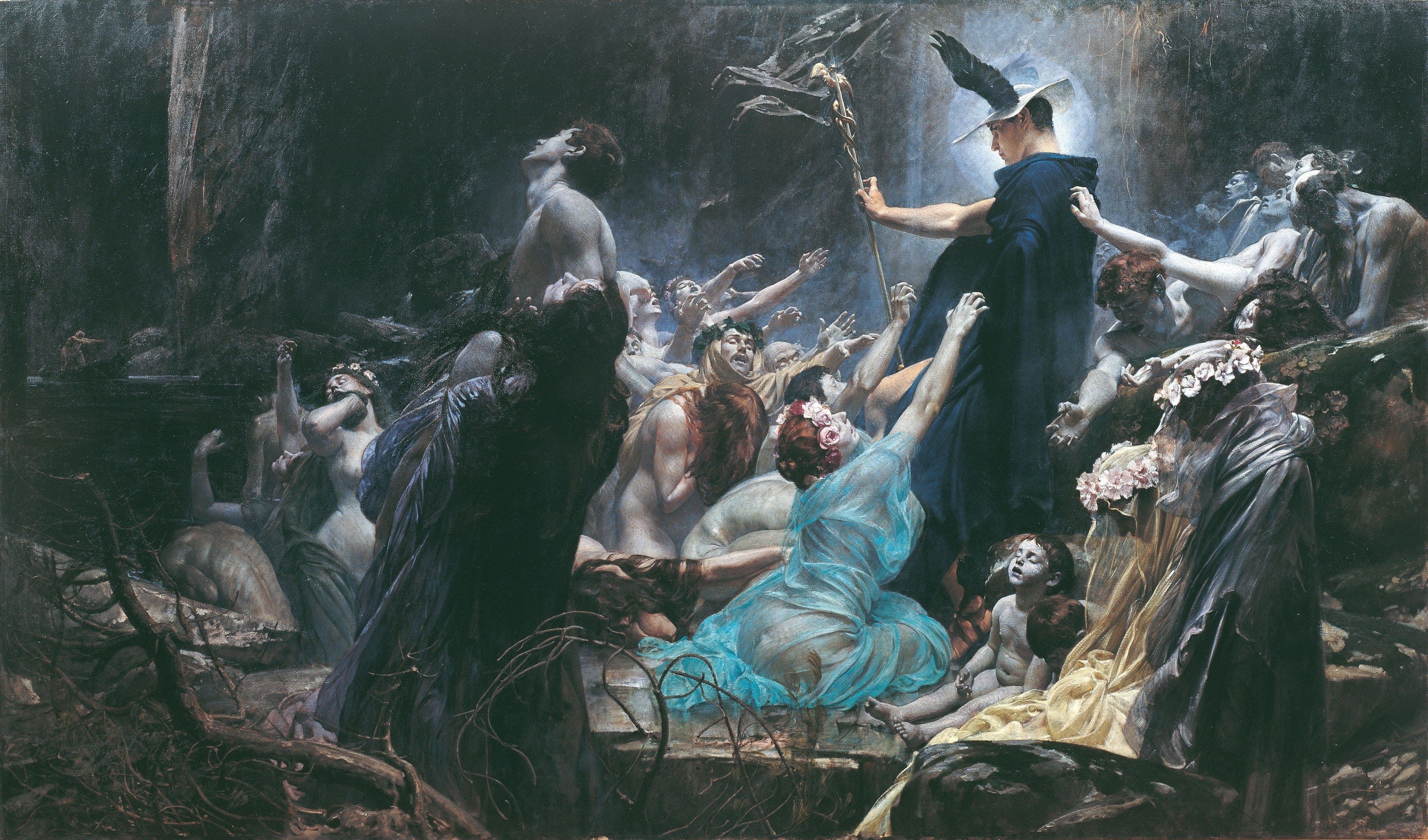
We’re back to that time of year where both Christmas and New Years are over, but winter has just begun. It is a dismal experience for Northeasterners such as myself. I can recall many long walks in the frigid nights of January over the years, and what I remember more than any sight or touch is the feeling of perseverance. Everything around you is dead, or is feigning death. The birds have left, the insects have perished, the waters have gone still, and the trees have lost their leaves. Inside the dormant lakes and trees, yet more stillness awaits, as the squirrels and frogs and similar such creatures have entered a deep sleep. The only living, moving thing is the wind itself, which relentlessly gnashes at anyone who dares to challenge it. How many men have been eviscerated by Boreas? How many souls has it blown straight from their bodies? How many journeys home has it stymied? How many ships has it blown off course, sending sea-dogs to their doom? Is it not ironic that the nose is so often the victim of frostbite, the very bodily appendage that was believed by the ancients to house the soul? The winter wind nose-dives down from heaven to launch a brutal attack on trespassers of the night, only to disappear as quickly as it came. When the wind stops, it becomes apparent that you are not only persevering against the wind, but against death itself! Without the wind, the stillness of the outside world comes into focus. It would very much like to claim you. Just as you lift your coat up against the external wind, the internal wind that moves your body is an affront to the placidity of the slumbering earth beneath you.
Walking in the night around this time of year makes me think of the underworld. Not the Lake of Fire described in the New Testament, but the underworld of the Pagans. When Odysseus arrives at the edge of the world, beyond the dreary land of the “Cimmerians”1, he offers milk, honey, and barley to the dead, before sacrificing a sheep. The ghosts or “shades” of the dead in hades live in ignorance of the world above, so frozen by their fate that the warriors still shamble around in the bloody armor they died in. Their intelligence and memory of their own lives and selves, without access to the blood of sacrifice, is dubious at best. The only way they can regain a semblance of their power in life and subsequently interact with the world of the living is by tasting the blood of the sacrifice, something they very much yearn for. One strange thing that Homer mentions is that Heracles, due to his apotheosis, is not actually inhabiting his phantom which resides in Hades. Instead, he is on Olympus, with the gods. The implication, or at least what I took away from it, is that most shades actually contain some element of the living soul. Otherwise, it would make no sense to contrast Heracles’s non-presence within his own phantom with the phantoms of everybody else. Odysseus also witnesses several people being tortured for impiety or immorality in the underworld, which is further evidence that hades are actually ensouled and have some sort of continuous experience.
There is a very controversial line in the Odyssey, when Odysseus is talking to the shade of Achilles:
I reassured the ghost, but he broke out, protesting, 'No winning words about death to me, shining Odysseus! By god, I'd rather slave on earth for another man some dirt-poor tenant farmer who scrapes to keep alive than rule down here over all the breathless dead.
I’ve seen some people interpret this as a repudiation of the fame-obsessed culture of the Homeric Greeks. Others view it as life-affirming, declaring the superiority of strife over numbness. Still, others have chocked it up to the story being about Odysseus, and subsequently seeking to glorify him by positioning him above the protagonist of the Iliad. I think anyone claiming that the message here is that living a long, boring life is better than living a short life is beyond delusional. It is stressed time and time again in the Iliad that mortals have no control over the hour of their death, and that it is inevitable. No amount of time on earth would change the inevitability of eternal death.
Achilles’s anxiety dissipates when he is updated on the successes of his son by Odysseus, and Odysseus’s death-wish is cast away by seeing the anxiety that would plague his soul if he failed to return home and secure his estate and family. This isn’t to say that the Greeks did not view the afterlife as something of an inferior state, but Achilles’s gloominess is emphasized only due to its relevance to Odysseus’s journey, as it highlights what is at stake if Odysseus is rendered both witless and powerless by death before returning. People ought to remember that the Odyssey is not a sequel to the Iliad, it is its own separate poem about its own character that is not necessarily meant to be read before or after the Iliad.
The early Romans, as per usual, had a more enigmatic view of the dead. They seemed to give them a jollier ending, joining their ancestors in an eternal banquet, but at the same time they rarely worshipped or interacted religiously individual dead ancestors. Instead, they only interacted with the broader mass of dead progenitors. Dumezil describes it in a very interesting way:
“The connection between the Manes of the dead man and the Genius of the living man was made, but at a late date. There is nothing to suggest that in primitive times the Genii were transformed into dii parentum. Emptied of his substance, evanescent, the dead man is still a complete being, but an anonymous being, lost in the immense crowd of his fellows.”
—Archaic Roman Religion, Part II
Here we begin to get a closer look into Indo-European, or perhaps more generally pre-Christian psychology, by which I mean psychology in the most literal sense possible. Psyche-logia — the study of the soul. In popular culture, the soul is the source of all non-material elements of a human being, but among Pagans it was clearly a composite thing which tore asunder upon the death of an individual. At the very least, there was the animus and the genius, which correspond roughly to the Platonic notions of the soul (psyche) and the intellect (nous). The Romans did not identify the genius with the living self, as demonstrated by Augustus’s discomfort with the Egyptians worshipping him as a “living god” (instead of worshipping his divine genius). The ideal, spiritual double to one’s soul is not the special knowledge of the Romans, rather it has parallels across West Eurasian folklore. The Norse had the Vörðr, the spiritual guardian of a human being that shared their shape. The Zoroastrians had the Fravashi, which projected the soul into the body. The Finns divided the soul into the löyly, the anima, and the Itse, which was the spirit of one’s identity or personality.
Augustine haphazardly characterizes the genius as equivalent to the soul, which is likely due to Aristotle’s own identification of Psyche with morphe. However, there is a difference between form in action and form in-itself, and Plato clearly recognizes that soul is just as much a consequence of the hylomorphic process as the body is. Unsurprisingly, later Thomists continue the equation of the soul in its entirety with the essence it inherits.
It’s very clear that the biblical soul is not the same as one’s form or essence, for two reasons. Firstly, it is implied in Genesis:
then the LORD God formed the man of dust from the ground and breathed into his nostrils the breath of life, and the man became a living creature.
The formation of Adam, i.e. establishment of his essential features into the body, occurs before the ensoulment of Adam. This is because the essence of Adam existed already in the mind of God, while to imply the pre-existence of the soul is regarded by most Christians as a heresy. It is possible I am mischaracterizing the Thomistic and Augustinian view on the soul, though, so if any learned men would like to criticize me here then please leave a comment.
The treatment of the afterlife in the Old Testament reflects the view of the soul as the animating force rather than the essential qualifiers as well. The dead go to sheol, which is described similarly to the Greek Hades, a spiritual mirror to the physical grave in which a corpse is inhumed. In the absence of the body, the soul continues to exist, but in a more dormant state. The Mesopotamian tradition is more extreme than both of these, coming closest to identifying the underworld with the grave itself. In the Epic of Gilgamesh, the “House of Dust” as it is called, is without light. Its inhabitants have only mud to eat, and dirt to drink. The only way for a dead man to be relieved of his thirst and hunger is if his descendants provided for him, which was often done through literally pouring libations into a pipe that leads to their tomb. Both Semitic and Egyptian burial rites were very deeply concerned with some sort of preservation of the body, which stands in contrast to the transition from inhumation to cremation across the Bronze Age Indo-European world. The Egyptians, of course, put a great deal of time and effort into mummifying their kings, and the Sumerians believed that the complete destruction of the body also meant the annihilation of the soul. The entanglement of the soul with the body is a very important theme in Abrahamic religion too, and the emphasis on the resurrection and restoration of the body is the main reason why Christians and Muslims are against metempsychosis. And yet, belief in reincarnation (at least on some occasions) coexists with the belief in an ostensibly permanent afterlife in many Pagan cultures. How could that be? The Celts were alleged to have believed in reincarnation by many Classical sources, and yet are also described by medieval sources as having believed in a realm of the dead across the ocean. The Germans have several final resting places for the dead before Ragnarok, and yet there are occasionally cases of reincarnation (or something similar) in Norse literature. Even among the Greeks, reincarnation was stressed among the Orphico-Pythagoreans.
I think it has to do with the aforementioned division of the soul among the Pagans. Most Abrahamic groups that have historically believed in reincarnation have been Gnostics or gnostic-adjacent, because these groups also repudiated the idea of being returned to their flesh-prisons as some sort of reward. However, the belief in reincarnation is actually not historically uncommon among the Jews. Albeit, it isn’t quite the eternity in Samsara that the Dharmics propose, but it’s something. Knowing this, I decided to do some investigation on my go-to spot for espionage on Der Ewige Jude, the Mi Yodeya Stack Exchange…
The concept (Gilgul) is apparently post-Talmudic in origin, and is wound up in Kabbalistic mysticism, which is hardly surprising considering the heavy Neoplatonic influence on Kabbalah. Isaac Luria, who I’ve discussed before as one of the most influential Kabbalists, believed that each incarnation of a soul would be resurrected at the end of days, as they are all separate components of a broader soul. Likewise, all human souls are considered to descend from the soul of Adam, which explains why everyone carries the sin of Adam. So, in actuality it is only the case that distinct souls are generated by certain qualities of a greater essence, which itself as a whole generates a meta-soul that comprises all of these different souls.
Make what you will of it, but it did remind me of a conversation I had with a Christian Platonist on here (Praxius) a while back, as I was curious how one can support Christianity while identifying with the very pro-reincarnation Traditionalists. He gave the following explanation on reincarnation:
“What I outlined in principle when I’m asked this is that there seems to be a reciprocal relationship and mingling between what might be called “bio-spiritual essences” and the actual instantiated humans that occurs by the cycle of life and death, to the effect that the individual soul is never recreated but the essence from which that soul is created might influence the creation of a similar individual. I use a water tank analogy here; inject some blue food dye into a glass of water, green dye into another, yellow into a third, and red into a fourth. You’re the green one. At death, you get poured back into a bigger basin of clear water and scooped back up again, what you’ll get is a glass of diluted green water integrated with a lot of clear water, you’ll never get the same 1:1 ratio of particles into the cup again, so the new “green glass” is less green than before and contains traces of the other three colors. Over enough rebirths, the green is diminished completely such that there is no longer an idea of a green glass. This is more or less how I see reincarnation. This is mostly supported by totemism for the lower castes and the patrician lineages for the upper ones, whereby the lower is more the recreation of a given type whereas the upper is more the recreation of a personality as opposed to an actual 1:1 recreation of a person.”
Whatever is the case, it is clear that there is something about people that continues after their death, but did not exist before their birth. Is it their accidental qualities? Accretion that has occurred during life? Is it the memories they have given to others? Is it their “pneumatic vehicle”, their okhema, which experiences fluctuation on behalf of the unchanging essence, and mediates the influence of the essence into the body? In the case of the latter, what vehicle exactly is it? Proclus describes the existence of a long list of vehicles which are contained within each other in a manner similar to a matryoshka doll. The problem with debates about the soul, and subsequently reincarnation, is that it is used to describe almost any conceivable non-measurable component of someone in some contexts. Christians handwaved away the idea of reincarnation, but incorporated the Pagan underworld into their perception of the location of sinners and nonbelievers prior to the final judgment. This isn’t just a one-time thing with our English use of the term “Hell”, or the use of the term Hades in the New Testament. The term “inferno” is derived from the Roman underworld. Christians in Japan used the term “Yomi”, their own shadowy land of the dead. The Finnish Tuonela, a realm which has basically all of the qualities of the previous three, is used as a translation for Hades in much of the Baltic-Finnic world as well. While existence in Hades is not as the lake of fire that awaits post-judgement, the condition of the shade as losing both its body and its identity is easily interpretable by a Christian as a re-wording of the isolation of the damned from God, and their inability to be resurrected. Hades, in this sense, functions as a taste of what is to come, in the same vein as Heaven being a taste of Paradise.
Likewise, salvation as a cessation of incarnation occurs through the re-unification of a human being with their divine nature, and so only that instance of a soul-class would achieve salvation. The rest would continue to exist only in Hades. The reason Luria does not go down this route has to do with his own soteriology being quite different from that of the Christians. It’s also possible to associate the conditions of hades with the “soul-sleep” that many Lutherans believe in, or even the Limbo of the Patriarchs (and of the invincibly ignorant, according to some).
All that being said, this is obviously not the only interpretation of the Pagan underworld. While many Greeks recognized escape as miraculous, others treated it as a temporary stop for the entire soul between earthly incarnations. Plato, in particular, lambasts those who demonize the state of death as something awful and dreary. The underworlds of many eastern cultures became syncretized with Buddhist conceptions of hell, which is often only a temporary destination. Just as there is friction between the Christian notion of the resurrection, and the Pagan notion of the permanent fracturing of the soul, I have also heard Pagans from eastern cultures (namely, Japan) try to distance their conception of the afterlife from the Buddhist perception. For those dissenters, it is very important to stress that the souls of the dead remain just as close to us as their graves are.
I came into this post with a lot of ideas, but I’ve come out of it unable to make a conclusion. I might actually be more confused coming out than I was going on, but hopefully this post will still teach you something and inspire some discussion. I think I’ll have to spend a lot more time thinking about this and doing research than I thought coming into this post, so there might be a redux some time in the future. In the meantime… I have recently hit 2,000 subscribers, which for Substack is like having 2 million subscribers on YouTube… Any ideas for how I should commemorate? Do you guys want another Q&A?
Homer was possibly referring to some non-Cimmerian, completely different people living in Southern France.
What's interesting is that here in southern Aus, it's mid summer, but the mood is the same, because with our summer comes incredible heat, fire, drought, death and desiccation. The horizon bends and warps in a Blood Meridian style heat haze of doom and despair, something huge and deadly lurks, brooding, ancient, demonic. It laughs at the attempt of civilisation here and I gather will one day gleefully consume it. Its why the natural rural Australian character is incredibly fatalistic and cyclical.
It seems that the time of Capricorn always brings this feeling whether hot or cold.
Speculation on metaphysics is mostly worthless because its unverifiable as you say, not only this, but the thicket of views is so dense that not even an infinite amount of lifetimes could lead to discursive victory in such matters.
However there are arbitrary certainties such as causality that come into play with these kinds of questions. That can be inferred and perhaps even intuited without much systematic entrenchment.
It’s not that there are any new composite elements being generated by incarnation, as all particulars have potential existence “before” they’re actualized in consciousness. This means that from the perspective of the ultimate, there is no such thing as “novel” phenomena, even if we make note of the vast diversity of beings and differences in the qualities of various lives. Existence and its categories are without any particular beginning and are ultimately generated “infinitely”, what we consider gain or loss is wholly provisional in respect to eternity.
That being said, fate or karma(causality) just continues in the direction or path that preceding causes have ordained. It matures in respect to “causes” and their subsequent conditions. It’s often why vocabulary surrounding these topics generally have agricultural nuances.
“Seeds”, “fruit”, “fructification”, etc. They are cognitive metaphors describing time and its internal mechanisms, that would be relatable to sedentary iron age peoples. Basically, a person, being, its life quality, and the details of their consciousness, etc, all “erupt” from the soil(potential). They are all nurtured and conditioned by the quality or even location of their planting. Instead of an idea of a particular soul that garners ethereal or metaphysical material in time, we see it that conditions themselves are all that there is. Conditioned existence is nothing but reactive and reflexive results of causes, which is their maturity. This is why the Dharmic positions tend to not suggest the notion of a “personal” or individuated soul or soul(s). In that way, a “soul” would just be the totality of psycho-physical properties(the five aggregates).
So what originally existed was causes and conditions, and what will persist, is more causes and conditions. This causality is without discernible beginning and in truth, is entirely “virtual” metaphysically speaking, as all phenomena is accounted for in registry by the three marks; emptiness, impermanence and suffering.
A being with right discernment and perfected wisdom, experiencing innumerable instances of their past lives or the past lives of others, knows that this process has gone on primordially with the potential to endure eternally.
Beings become gods, descend to hellish realms, are born as animals, humans, etc, in accordance to their intentions and deeds via body, mind and speech.
I don’t think that any conditioned existence is a possessive or something garnered. At least not as a kind of owner and owned metaphor/system. It’s more like instances of consciousness perpetuating conditions that ensnare it further and further into coarser complexity.
Maybe inversely, reversing or otherwise shedding various kinds of conditioning in the event of true spiritual cultivation. As we can somewhat depict “salvation” or liberation as consciousnesses perpetual self-awareness or enfranchisement, hence it being described as “awakening”.