
Gladiator in Retrospect
Reviewing the penultimate great Sword and Sandal film.

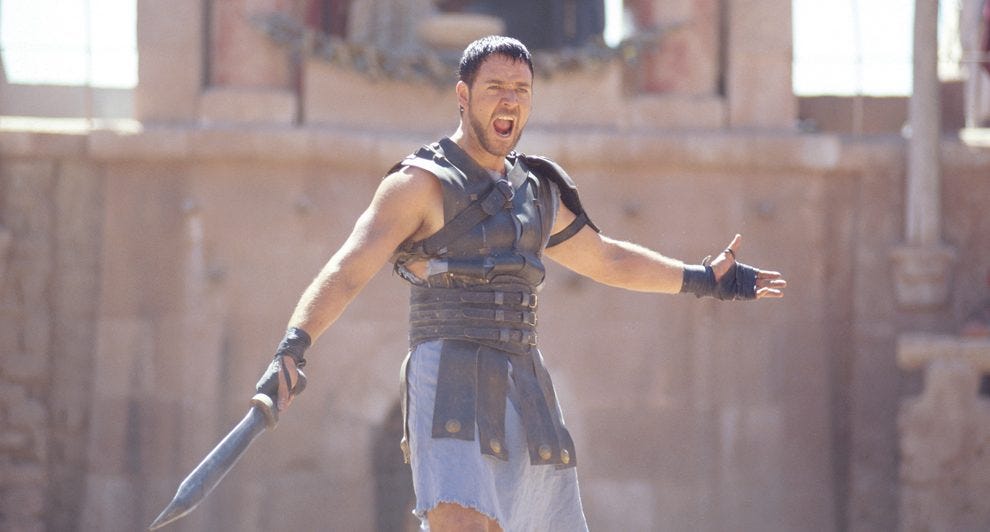
If any single piece of media defines the contemporary image of The Romans, it is Ridley Scott’s Gladiator starring Russel Crowe. I have seen this movie more times than I can count, but I’ve put it on in the background just to set the mood, because as I said it is one of the last great Sword and Sandal films. I say penultimate, because I would say the final one would come out four years later in the form of Troy.
I would consider Gladiator part of a unique genre that was really popular in the 90s and 2000s, which I call “white guy goes native”. Gladiator is on the absolute fringes of this genre, but the more mainline examples are The Last Samurai, Dances with Wolves, and Avatar. It revolves around a White military man getting cast out of his position as spreader of “the civilization” (which is seen as inauthentic, dishonorable, and degenerated) either on accident or due to some sort of dispute with his comrades. He then goes to live with the “barbarians” and becomes one of them, and fights against the civilization.
In Gladiator, we have a movie that is only loosely resembling this structure. First of all, it’s in antiquity, but the Romans are the closest thing we have to the “Americans”. Rome is viewed as the birthplace of The West, while the gladiatorial slaves don’t represent any indigenous group so much as they represent the multicultural underbelly of the empire. Maximus even cuts out his ‘SPQR’ tattoo as a representation of his “going native” (such tats were only for identification purposes, by the way. The romans and Greeks despised tattoos). They are all barbarian warriors, likely captured in battle, while Maximus is our “white guy” civilized Roman. Albeit, Maximus himself is a colonist and potentially of barbarian stock, he is “The Spaniard”. Iberia was very heavily peopled by Romans, a good deal of Roman POIs were from Iberia such as Hadrian.
Most of the movies in this genre are subversive in the sense that they seek to portray Westerners as the bad guys. In the case of Dances with Wolves, explicitly so. In The Last Samurai, it is more morally grey. The Emperor and the Americans are portrayed more as hesitant modernizers, who don’t necessarily hate the old ways of Japan but simply want Japan to be strong and join the civilized world on equal footing. The portrayal of the Shogunate and their feudal allies, by the way, is inaccurate. The Samurai used guns, they used modern weapons, they were not Injuns who lived in seclusion. They were sort of like the Confederates in their mentality if anything, if I understand correctly.
In Gladiator, there is a different subversive element. This time, we get this entirely made up story that Marcus Aurelius wanted to restore the Republic. There’s no evidence Marcus Aurelius ever felt this way, it’s entirely fabricated in order to give a movie about Imperial Rome an American political message. Which is especially strange, because Ridley Scott is an Englishman. The point of the movie is basically “democracy LE GOOD, dictatorship LE BAD” despite the movie taking place over two centuries after the collapse of the Roman Republic, during which time the Empire prospered specifically because of autocratic rule. And I don’t say that as some fan of the Empire. The Empire was a necessary evil, it was a necessary response to a population which had fallen into degeneration. A republic is only as good as its people.
At the same time, the movie reflects the vision of “Rome as an idea”, “Rome as values”, very popular idea of America in the 90s/2000s. “America isn’t a people, it isn’t even a culture. It’s just values”. This runs contrary to the real people in Rome most scornful of imperial autocracy. Republicanism in Rome was associated with conservativism, elitism, and a more ethnic view of Romans. Cato the Younger was almost autistically dedicated to Roman tradition. He wore a toga all the time, and he walked barefoot everywhere instead of taking a carriage or a horse. Walking everywhere was the Roman way. Roman conservatives like Tacitus were generally more cynical about emperors. Especially as the empire went on longer and longer, straying from the virtue of Augustus, who only wanted to save a people he knew were already destroying themselves. Even late in Roman history, we see the Julian (who is the TRUE philosopher-king of Rome, not Aurelius the weenie) seek to erase much of the autocratic reforms of Diocletian as part of a general program to RETVRN…
Yeah, speaking of which, I think I’ve made it pretty clear that I’m not the biggest fan of Marcus Aurelius. I mean, I don’t hate him, but I hate that he has not only become the most popular emperor but also the most popular philosopher of antiquity in America. He didn’t even want his writings to be published, they were for himself only and were extrapolated from other Stoics. His reign was superior to the century-long hellstorm that would follow, but it was not exceptional. I have said before, you go to any Barnes & Noble in America, go to the philosophy section. If it isn’t some shitty self-help book with swear words in the title, it is some “Stoyk” shit. There will be a bajillion copies of Meditations, meanwhile from the Greeks you will struggle even to find works from Plato! This movie is probably, hmm, 70% of the reason for this I would suspect.
Otherwise, it takes some less intentional historical liberties. Gladiators did not really fight to kill in the arena, but it happened often anyways. And many who were wounded would die after their battles. Commodus was maybe more of a “Mr. Satan” type figure, he did fight in his own staged gladiator fights and was seen as somewhat cowardly, but he was also very physically domineering and not just a pretty boy. Commodus is such an interesting character in the movie, that I excuse it. A lot of the armor is inaccurate, like I noticed they showed an Anglo-Saxon helmet in one of the scenes. Probably the worst inaccuracy (aside fro, the whole “Marcus Aurelius is Republican” thing) is at the beginning of the film. The Germanics are portrayed as hill folk, orcs, literally swinging around fantasy warhammers, meeting the Romans in open infantry battle as a massive horde. The Germanics obviously did not look like they did in the movie, they had a similar cast of weapons and arms that the Romans did, albeit they were known for going into battle shirtless.
The opening scene of this movie, although accurately portraying Marcus Aurelius’ reign which was spent on-and-off fighting against the Suebi, has perpetuated the impression of Germanics as the constant and major enemy of the Romans. In reality, the Romans were largely at peace with the Germanic tribes for the entire 2nd century with the exception of the reign of Marcus Aurelius. The Germanic tribes only really became a big issue for the Romans later in Roman history, when the army was a shadow of its former self. Rome did not have much ambitions to conquer Germania, as the Rhine made a very defensible barrier, but they were constantly fighting over Armenia, Mesopotamia, and Syria with the Persians. Rome’s greatest enemy was obviously the Persians, who were both a constant and a formidable foe. Even after the fall of Rome, the Byzantines and Sassanids fought bitterly over multiple decades-long wars until they had exhausted themselves so thoroughly that both powers were overwhelmed by the Muslims.
There are some surprising accuracies, albeit. The Nubian’s haircut, the realistic Pilums, the sale of nights with gladiators to wealthy women. Gladiator is still, at the end of the day, a brilliant movie. It’s amazing, the action, the plot, it was good which is what makes these elements so penetrative in the popular culture. While in the technicalities, it is far more historically accurate than Troy, I would somewhat say that Troy sticks to the essence of its source material more. Troy, despite its changes to the story of the Iliad, does still feel essentially like the Iliad. Gladiator, while set in Rome, feels like it is a story for Americans. Apparently Ridley Scott is making Gladiator 2. I don’t have high hopes for it, I think Ridley Scott has lost his marbles and also I think movies just suck nowadays and there is no vision for the sort of action blockbusters of the pre-CGI era. Historical flicks are also pretty much universally bad nowadays, they’re all subversive, but not in the way Gladiator is. Gladiator falsifies history to give off some sort of modern relatable message. Historical flicks now instead posture themselves as “historically realist” and do their best to make history as gritty and undramatic as possible. I don’t think any great Sword and Sandal films have come out since Troy, unless you count 300. I don’t count Alexander, a film taking place in the B.C. era doesn’t make it Sword and Sandal.
Final message, when I was young this movie made me imagine Odysseus as Russel Crowe, because when I was young and reading simplified Odyssey in school Odysseus reminded me of Gladiator. Both were veteran super-warriors who just wanted to make it home to their family. It’s funny though — the Romans HATED Odysseus. They hated his trickiness, his scrappiness, his plots and schemes. He was not pious in their eyes. The Greeks, they were totally different animals from the Romans. The Greeks were real bloodthirsty barbarians, not the Romans. The Romans were much more tempered.
the samurai loved guns so much that at one point during the sengoku jidai there were more guns in japan than in all of europe at the time. Also im pretty sure the portuguese dude who introduced guns to japan has a statue of him somewhere in Kyushu
I really enjoyed this movie growing up, but the depiction of Aurelius and the Germans at the beginning has since made it almost unwatchable for me - I just like the action scenes and the setting at this point. The shame is that the era is rife for movie story-telling, but of course, it will never be covered properly... its lucky we even ended up with a movie like the Northman, every new thing seems to suck these days. Gladiator 2 will probably pale in comparison to the first.