
Brief Thoughts on Homer
He dropped his donut, d'oh.

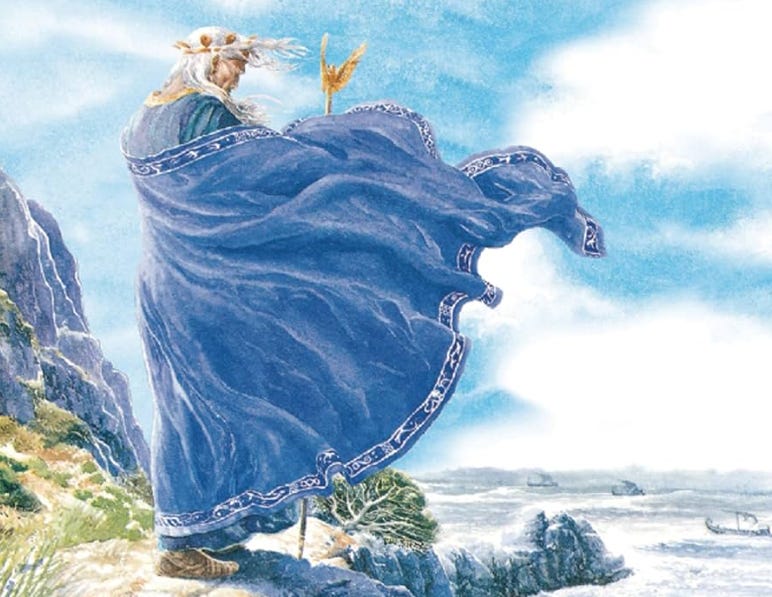
I HATE YOU CHRISTOPHER NOLAN!!!!!!!!!! FART ON THE HEADS OF ANYONE WHO DEFENDS THE NEW ODYSSEY MOVIE!!!!!!!!!!!! #ThrowPoopAtChristopherNolan2026
No, I haven’t watched it. And I never will! But here are some of my takes on Homer and more specifically the Odyssey. I haven’t actually read Homer in quite some time, so I am open to criticism just as I was in my LOTR post.
The Odyssey’s most overt theme (if it has any — more on that later) is about the importance of Xenia, the ritualized hospitality system of the Greeks, as well as various related reciprocal relationship systems between free non-related men in Greece and many other parts of the Indo-European world (and beyond?). Most of the bad guys in the Odyssey are bad because they are either terrible guests (the Suitors) or terrible hosts (Polyphemus, Circe). When Odysseus’s crew slaughter the cattle of Helios, it is not Helios who smites them, but Zeus, because Zeus is the protector of Xenia. The relationship between kings and their clients is also, in fact, a relationship between host and guests.
The Odyssey is a pious book, certainly not about “defying the gods” like Nolan suggests in trailers. Bad things happen to people who defy the gods. Consequences for transgressions against the gods are swift and cruel. Good things happen to people who trust them. Odysseus does not gain any sort of permanent victory over Poesidon, he simply endures his wrath until he can finally return home to make penance with the sea-god.
But, on the topic of Poseidon, Homer does seem to sort of have a gripe with him. Poseidon was very important in the Mycenaean period (if sacrificial records are anything to go by), maybe even more important than Zeus, but Homer heavily glorifies Zeus and sort of miniaturizes Poseidon into a destructive spirit of nature. I believe that Homer was sympathetic to a new Zeus-centric religious fabric heavily influenced by the spread of Doric Greeks during the early Iron Age, which itself may have connections to the very pronounced roles of Zeus-adjacent figures in the religions of Adriatic peoples such as the Illyrians and Italics.
Homeric epics, like pretty much all bardic epic narratives, existed partially to inspire young warriors into acting heroically on the battlefield by echoing the great deeds of warriors long-past. So, in some ways it’s kind of like the Military-Entertainment complex of antiquity. This doesn’t mean that Homer is pro-war. Much of the Odyssey makes it quite clear that the Trojan War was an extremely painful experience that has left the fighters with grief for their lost friends (although hardly any guilt for the destruction they dealt to Troy), but war was an unavoidable reality of life in the Greek Dark Ages. Calling Homer “pro-war” or “anti-war” would be like calling a Farmer’s almanac “pro-food” or “anti-toil”. The Odyssey is a glorification of Odysseus’s “polymetis”, his general practical skill and excellence at problem-solving. Odysseus’s moral choices are an expression of this, because he is constantly aware that violating the rules of justice of the almighty Zeus cannot result in anything good. The Greeks, in other words, were believers in “skillful means” (उपाय) as the Buddhists would say… The Iliad glorifies different virtues than the Odyssey. I guess you could say, Homer (and most other epic bards) are pro-Warrior, but not pro-war. The wars they record are closer to bloodsports than to modern military conflicts and perhaps even the conflicts of classical antiquity.
On that note, I do like Proclus’s idea of the Odyssey being about Henosis. It doesn’t matter whether or not it was intended to be about that. I think pretty much all ocean survival movies are about this, because “the deep” has always been identified with the primordial chaos which corrupts matter and builds up great tribulations in one’s life. Birrin talks about this:
The relationship between what the Neoplatonists call the two Ones is shrouded in mystification in most natural religions, all of which feature a familiar element with which to convey this mystification: water. In such myths, water takes on the role of the generative/feminine/universal aspect of God, as it is an unformed substance which only takes shape when forced to and which may take the shape of anything. Further, water is “reflexive” in that it can only be self-referential in the way it takes form, always remaining true to itself. In this sense, God is “self-reflexive” in that He, like water, upon “taking shape” is the “storehouse” of all the describable features and qualities of our provisional universe.
Let us now engage in a thought experiment and construct our own water-based analogy: Imagine one scoops a cup of water out of a lake and declares a “new water” separate from the great lake, but when spilled back out into the source the distinction dissipates. One would not say the lake is composed of individual cups of water. Nor would one say that the water which spills out into the adjoining rivers and streams is at any specific point tangibly separate from the water of the lacustrine source. Truly, there is no individuation of beings or things or substances; all being finds its share in pure Being, from which it is inseparable. In sooth, there is no dyad of Being and being, only Being. Hence why Hindu cosmology tells of a great Causal Ocean beneath the “Lokas” of Reality, known as the Karanodaka or Garbhodaka Ocean, where Vishnu (God) is said to lay down and create the material world. At the “bottom” of Reality, at the most fundamental degree (or greatest point of abstraction), we see the “masculine Creator” or the “Subsistent Act of Existence” “producing” the “feminine Generator” who is all content.
This is also why I like the Life of Pi, possibly my favorite movie!
Life of Pi and the End of Western Indophilia

I’m rewatching Life of Pi. It is a beautiful movie. The main character, Pi, is a fairly gifted son of a well-to-do Southern Indian zookeeper. The city’s middle class and wealthy live in a very different way than the poor. Pi is obsessed with the metaphysical questions of life, but his father is a “rationalist” who believes in science and progressing Ind…
The Trojan War probably is a composite story of multiple attacks on Wilusa (and perhaps other Luwian coastal settlements?) by the Greeks spanning from the early Mycenaean period all the way to the Iron Age. I think that it definitely preserves from memory of the Palatial civilization though, and I do think the similarities between Agamemnon’s travels and Odysseus’s “Cretan lie” are conspicuously similar to the voyages of the marauding Sea Peoples. These Sea Peoples are often treated as more mysterious than they really are. Archaeogenetics, archaeology, and written stories of the people of the Eastern Mediterranean strongly confirm a Greek origin for at least a great deal of them. If we’re going to talk about the Hunnic confederation as “Hunnic”, then we might as well just start calling the Sea Peoples “Greek”, because they were probably more Greek than the Huns were Hunnic. Because the Trojan War is a composite event, it would be fine to use styles from the Greek dark ages, but it would not make sense to use styles from hundreds of years after the death of Homer.
Achilles in the Odyssey is a different character from Achilles in the Iliad. The Odyssey is about Odysseus, and so Achilles exists in it only as a means to the end that is Odysseus. The vice versa is true in the Iliad, albeit the Iliad is less Achilles-centric than the Odyssey is Odysseus-centric. When you read Achilles’s shade moaning about how much it sucks to be dead with nothing to his name, you are supposed to think “wow, Odysseus really needs to get back to Ithaca so he can avoid this fate”. Odysseus needs to not die so that his kingdom is not ruined by the suitors, not because death is something you should do absolutely everything to avoid for a maximum but cosmically short amount of time.
Homer was a real blind guy who orally composed most of the Iliad and Odyssey. However, regardless of whether Homer was one guy or multiple guys across centuries, or something in between, thinking of such works as having concrete “messages” is probably not the best way to go about it. The goal of the Bard was to create a coherent but magnificent world that has a sort of subtle existence or relevance in mundane life. The myth is not a means to an end, it is the end in-itself. To the Greeks, Achilles and Diomedes were more real than you and I, and the goal was to align one’s life with myth instead of aligning myth with one’s life. This difference of opinion on what a story’s utility is explains a lot of the differences in taste between people today, with left-wingers typically being more on he side that stories and works of art are only as useful insofar as they communicate a message. The people with the most antique mindset are usually “fanboys” who get upset about inconsistencies and inaccuracies that break immersion in fictional worlds.
Homer is kind of an Iliophile. Like, I’m not one of those people who says that the Iliad doesn’t have a clear protagonist — it is indeed the Greeks — but if Homer didn’t have a soft spot for Troy then his writings wouldn’t have made half of the ethnic groups in West Eurasia claim descent from Trojans and use that fabricated lineage to justify fighting Greeks. The Trojans seem like, well, stand up guys. It’s not anything like how the Hebrews portray the inhabitants of the cities they sacked.
Trojans probably didn’t have a genetic profile similar to other Bronze Age Anatolians. They were right across the Hellespont from Thrace and had extensive alliances with them. Not to mention, their associations with Mycenaean Greece. I wouldn’t be surprised if they had more Steppe ancestry than the Greeks, although it’s impossible to say anything for sure because for some reason we don’t have ancient Trojan DNA! I really can’t stand shit like this. We have no Trojan DNA. We have no Southern Mesopotamian DNA. We have BARELY any Egyptian DNA. I believe illegal action must be pursued by daring vigilantes in the future to rob the graves of these areas in search of DNA in the ear bones… Some of you may be haunted by ancient Bronze Age ghouls for the rest of your days, but that is a sacrifice I am willing to make…
#ThrowChristopherNolanIntoABigStewAndCookHimAndThenEatHim2026

The ear bones are calling....
Wilusa, Wilusa, we need the bones of the Luwian. May Tarḫunz strike down any who hold back the bones of your noble men.
Great article. I just finished the Telemachy so I’m still early on in the story. Do you have any more insights on the shade of Achilles? I’ve heard from people more knowledgeable about these things than I that one’s shade is not a true reflection of a person’s soul. Rather it is a lesser version of one’s self. If this were true we should probably not take anything the shade says at face value. However I am far from an expert and would love to hear what someone more knowledgeable has to say about the matter.