
A Note on the term "Aryan"
Should Aryan be used as a stand-in for "White People"? What about Proto-Indo-Europeans?

For as long as I can remember being in the Indo-Europeanist sphere, I have seen people argue over whether or not it is correct to use the term Aryan en reference to Indo-Europeans writ large, or even modern-day Europeans as a race. I was writing my post on Pan-Europeanism, and almost added this as a small section to that, but I realized that it’s probably worth its own short post.
The term “Aryan” originates from the Indo-Iranic world. It is used in Indic texts mostly to describe noble people or qualities, especially in a religious context, rather than the folk. However, it was to some extent used to describe the Indo-Aryans as a people, but it’s very possible in these cases that the term “Aryan” was being used as a descriptive adjective rather than an ethnonym. For example, the Vedic tribes are said to have lived in “Aryavarta” (land of the Aryans), the lands where “Arya vac” (Aryan speech) predominated. Is this an exaltation of the land and language of the Rigvedic tribes? Or is it just calling them what they are? It does seem like the term Aryan function to some extent as an exonym for the Indo-Aryan peoples, as it is used to describe the northern enemies of the Tamils in the Eṭṭuttokai, the Eight Anthologies of classical Tamil literature. This was at a time, however, where we have ample textual evidence of the indiscriminate use of “Aryan” or “Arya” to refer to pious or noble behavior in Northern India.
This is contrasted heavily with its use in the Iranic world. We know that among the Scythians, the term “Arya” transformed into something more like “Ala”, hence why we have groups like the Rhoxolani and Alans. The term is used in the Avesta mostly as an ethnonym. Ahura Mazda is the “God of the Aryans”. “Airyanem Vaejah” is the homeland of the Aryans. Herodotus tells us that the Medes were originally called the “Arioi”, and Darius and Xerxes are both referred to on Persian inscriptions as being of Aryan stock. This creates two possibilities. The first is that Aryan began as an ethnonym for Proto-Indo-Iranic peoples, and then became a term associated with the nobility when the Indo-Aryans established themselves as an elite in the subcontinent, and from here it became associated with the perceived qualities of this elite rather than the elite group itself. The second is that Aryan started as a term describing nobility or piety, and then became associated with the Iranic peoples through its use as a descriptive term of their religious orthopraxy, all-the-while remaining as its original form in the subcontinent. One piece of evidence I often heard brought up in favor of the “ethnonym first” hypothesis is that the early Uralic groups (Seima-Turbino?) adopted the term “Orja” as a term for a slave or a servant, which is believed to come from “Arya”. This had to have happened pretty early on, as it is present in both Finnic languages and Permic languages (Udmurt, for instance). However, as mentioned earlier, the use of the term Aryan as an exonym didn’t always correspond to its use as an endonym. ‘
The problem with the term “Aryan” as an ethnonym is that, even if it was used as such among the Proto-Indo-Iranics, there is a dearth of evidence for cognate terms in other languages. When terms are suspected of being cognates, they usually tend towards the “nobility” side rather than the endonym side. Arjaz (Germanic), Arios/Aire (Celtic), and Aristos (Greek) all refer moreso to someone’s rank or virtue than they do to their ethnicity or clan, and that’s being very generous and assuming all three of these actually do come from the same word as ‘Aryan’.
The second problem with Aryan is that, not only is there very little evidence to suggest that it was used as an ethnonym by the Proto-Indo-Europeans, but there are also words which are equally likely to have been used as such. For example, the term “Teuton” which is today mostly limited to reference to the Germanic peoples. Historically, however, it was represented not only as the name of the actual Teutones, but also the Irish túath (think: túatha de Danann) and the Albanian tëtanë, both referring to something along the lines of a people or a tribe. This may have originally just referred to any tribe, rather than the early race of Indo-Europeans, though. However, I think it’s worth noting that often times endonyms originate across cultures as terms simply meaning “the people”.
I’ve also heard people mention the term “Veneti” or “Venedi” as a potential descendant of the original Indo-European ethnonym, as words like it are used extensively in recorded history to refer to tribes speaking different Indo-European languages. There is the Para-Italic Veneti of modern-day Veneto, the Celtic Veneti of Britanny, the Baltic Veneti, and the Slavic Venedi (which may be where “Wends” comes from). You might see this and say “oh, well that’s just a few languages, just like Aryan”, but it’s worth remembering that Italo-Celtic likely branched off at a time where Balto-Slavic and Indo-Iranic were actually the same language. The two families are much more distant than Indic and Iranic are to each other.
The problem with using Aryan as a term to refer to all things Indo-European becomes clear when you think of it this way. If you called the Indo-Europeans “Teutons” it would be very confusing, because that word has come to mean “Germanic”. If you called the Indo-Europeans “Venetic” it would be even more confusing. And yet, this is what people do with the term “Aryan”. It implies that there is something profoundly deep or archaic about the Indo-Iranians, when in reality their formation as a group occurred centuries after the ancestors of the Germans, Italics, and Celts had already reached Western Europe. Their interactions with other Indo-Europeans was also rather sparse. Once the Balto-Slavs split with the Fatyanovo Proto-Indo-Iranics, they mostly did their own thing. The Andronovo expansion into Central Asia, as far as we currently know, didn’t involve any lineages associated with the Bell Beakers or more Western Corded Ware branches. Instead, it was mostly R1a-Z93 (Indo-Iranic) and R1b-Z2103, with the latter likely descending from earlier Yamnaya-derived Steppe peoples who were conquered and assimilated by the expanding Proto-Indo-Iranians. In Europe, Z93 is very rare today, and its only presence in the ancient record is two samples from Thrace, which may reflect centuries of cultural exchange between the Cimmerians and Thracians (if it means anything). You would think an expansion like that of the Aryans would be something very heterogenous, calling for adventurers throughout the interconnected Indo-European world, but no such thing occurred. Only the Aryans went east, perhaps because only the Aryans faced sufficient pressure from expanding Uralic peoples in the north. It is possible that other Proto-Indo-Baltic groups that inhabited Finland were pushed into Scandinavia, but they were eventually superseded by the Germanics.
So, calling Indo-Europeans “Aryan” writ large doesn’t make a lot of sense. It would be like calling Indo-Europeans “Germanic”. The term Aryan, in my eyes, should be used predominantly to refer to the Proto-Indo-Iranic peoples. If you want to call White people something other than “White people”, just call them Europeans, because that’s what the term means anyways. Also, it doesn’t have the bad optics and baggage that “Aryan” does.
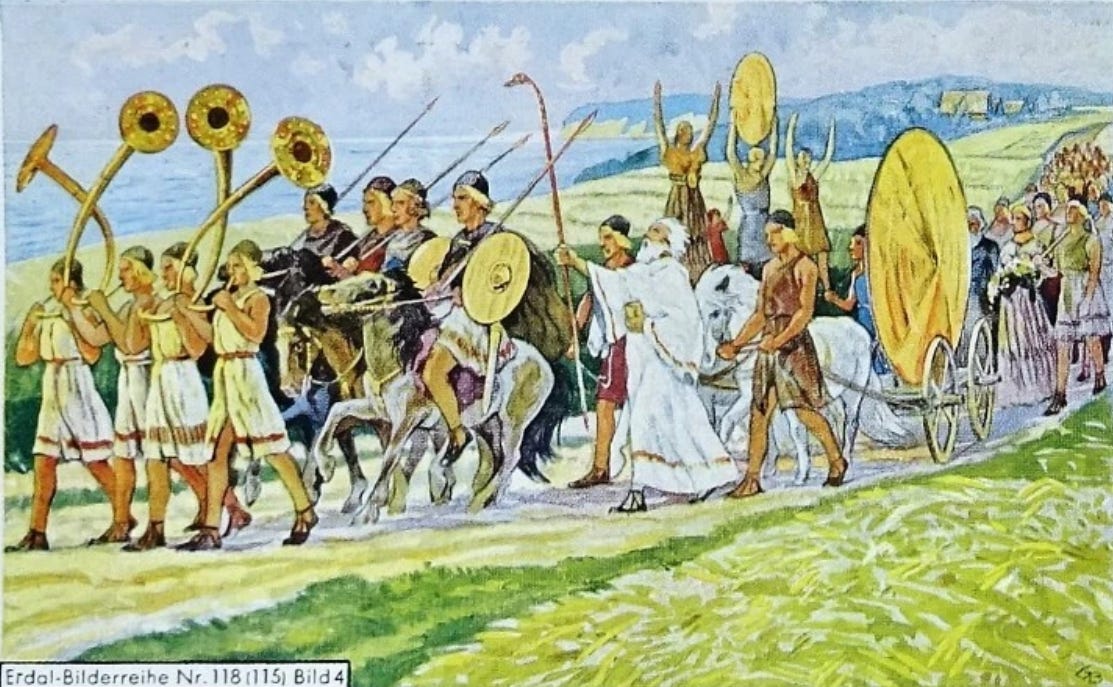
What’s kind of funny is that Aryan has become a term so strongly associated with the brightest and most pure-blooded White person that it has basically regained its (possibly) original meaning as having noble qualities. People in right-wing spheres now call good things “Aryan” almost as much as they call White people “Aryan”.
Example: This is Aryan.
Words change meaning so using "Aryan" as a chud slang term for white people and good things is good (Aryan) o algo
What about the reconstruction "heryos"?
I largely agree, as we have spoken about before, but I do use it sometimes in our circles because it is colloquially understood. There are also large amounts of WN folks who don't understand any of this archaeo-genetic timeline that you are talking about, and I don't always have the interest or expertise to explain it to them. In these instances, using Aryan gets the point across.