
The Protestant Work Ethic
Defending a reviled mindset


A few days ago, I was surprised to hear that Prosperity Gospel is much more prominent than I thought among American Protestants, and it’s apparently only becoming a greater share of American Christian belief.
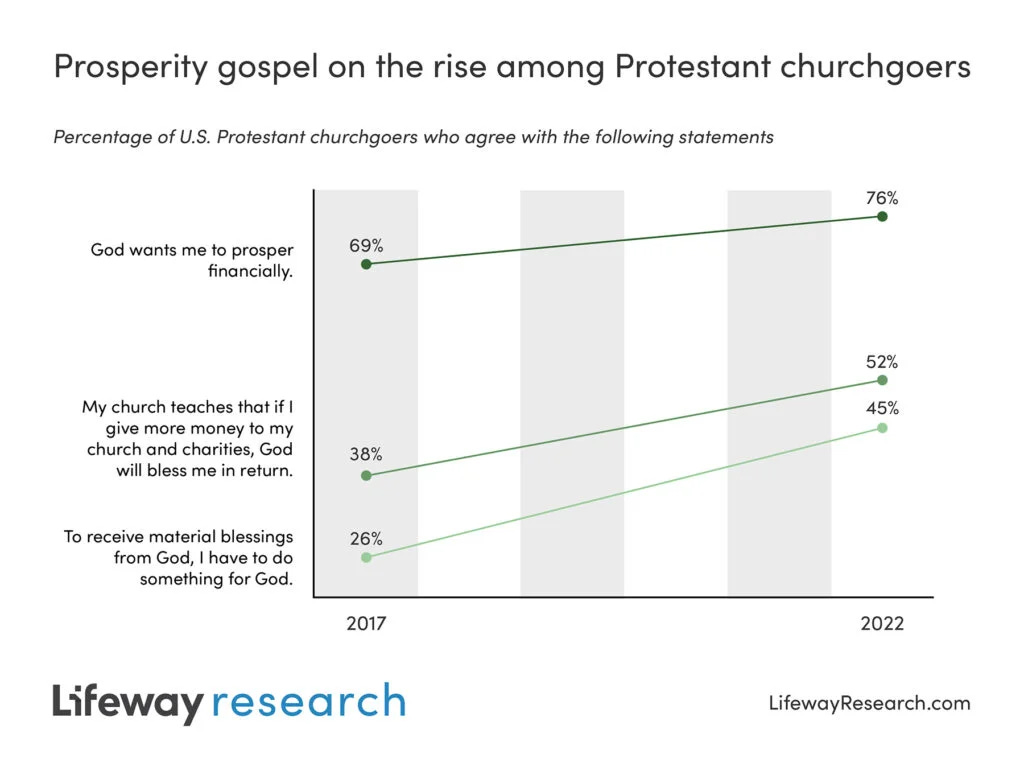
As shown above, more Protestants were enthusiastic about receiving material prosperity from God in 2022 than they were in 2017. Of course, these questions are somewhat misleading. We shouldn’t put it past American protestants, even their pastors, to accidentally disregard sola fide and state that God will bless them in a non-material sense for their works. But, it does appear that at least almost half of Protestant churchgoers believe that material blessings come to those who are faithful, and wealth is a sign of divine favor. While I doubt most of these people are Christians for the sake of earthly gifts, it is clearly an influential undercurrent in Evangelical circles that only bubbles up to the surface on the fringes. I was able to find a great article on the demographics of Prosperity Gospel, but unfortunately, it’s based on data from the ancient year of 2012, and it seems like prosperity rhetoric has only grown since then.

Obviously, there’s nothing unusual about Christians entrusting God with their fortune, but the expectation of it certainly doesn’t sound like what you find in the New Testament. Jesus is pretty insistent about disregarding material wealth as useless for the coming world. Interestingly enough, very few believers of Prosperity Gospel are actually rich. The key takeaway from the above-linked article is that Prosperity Gospel beliefs and Prosperity motivations are very much associated with the poor and with non-white people.
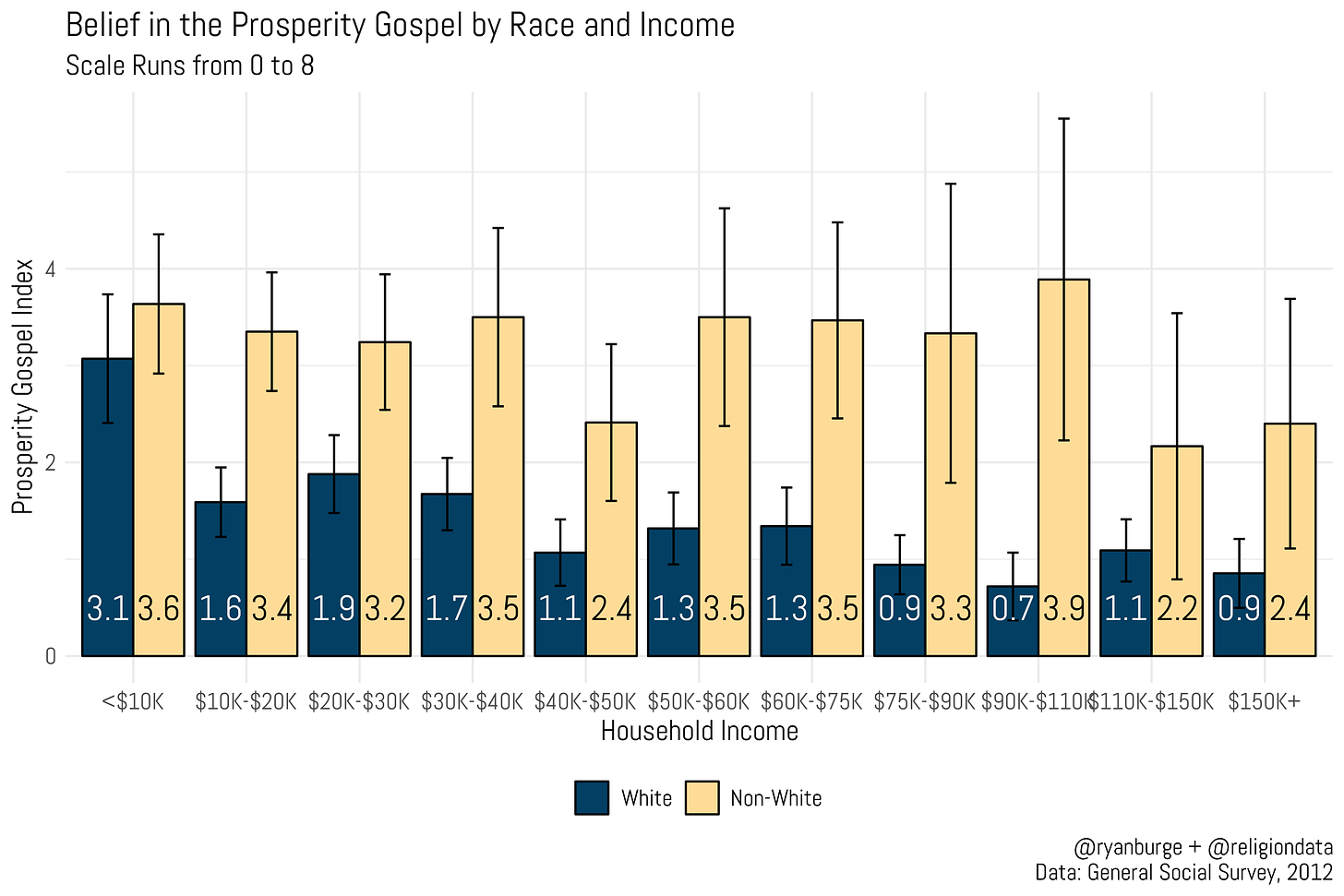
Whiteness was by far the most important variable in whether or not someone believed in prosperity gospel,
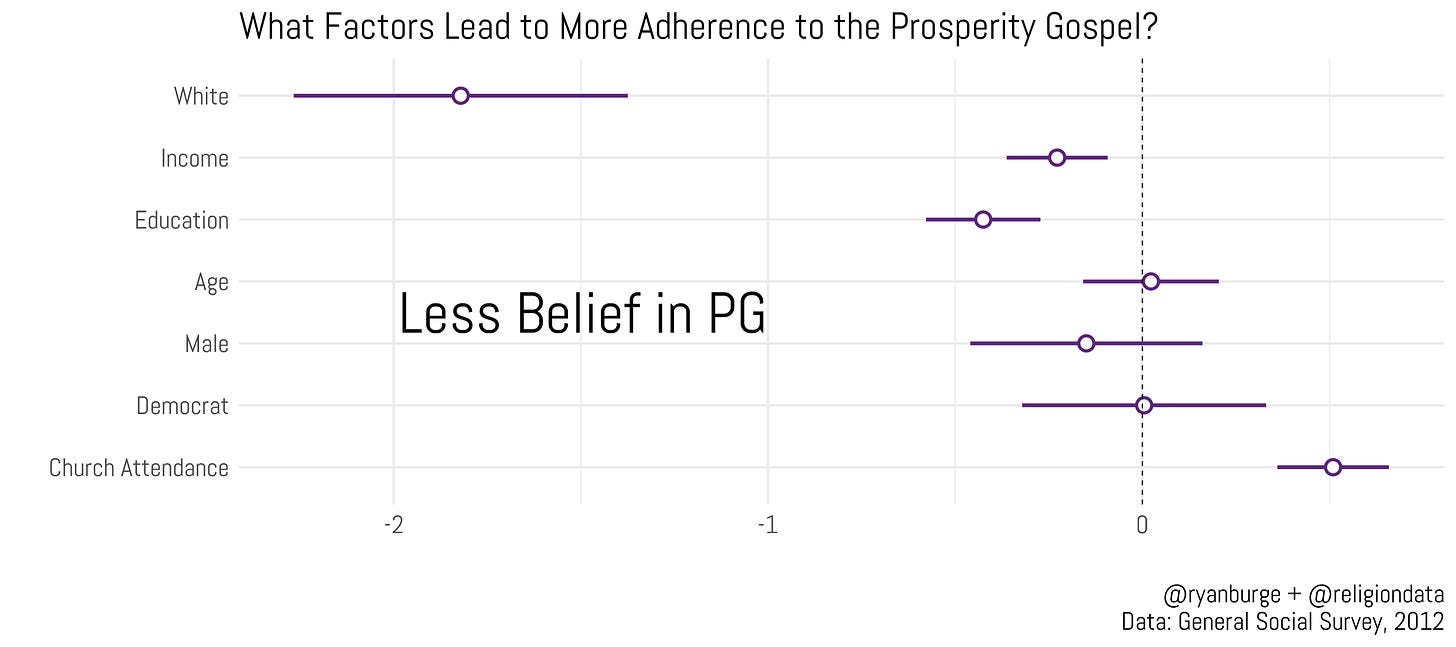
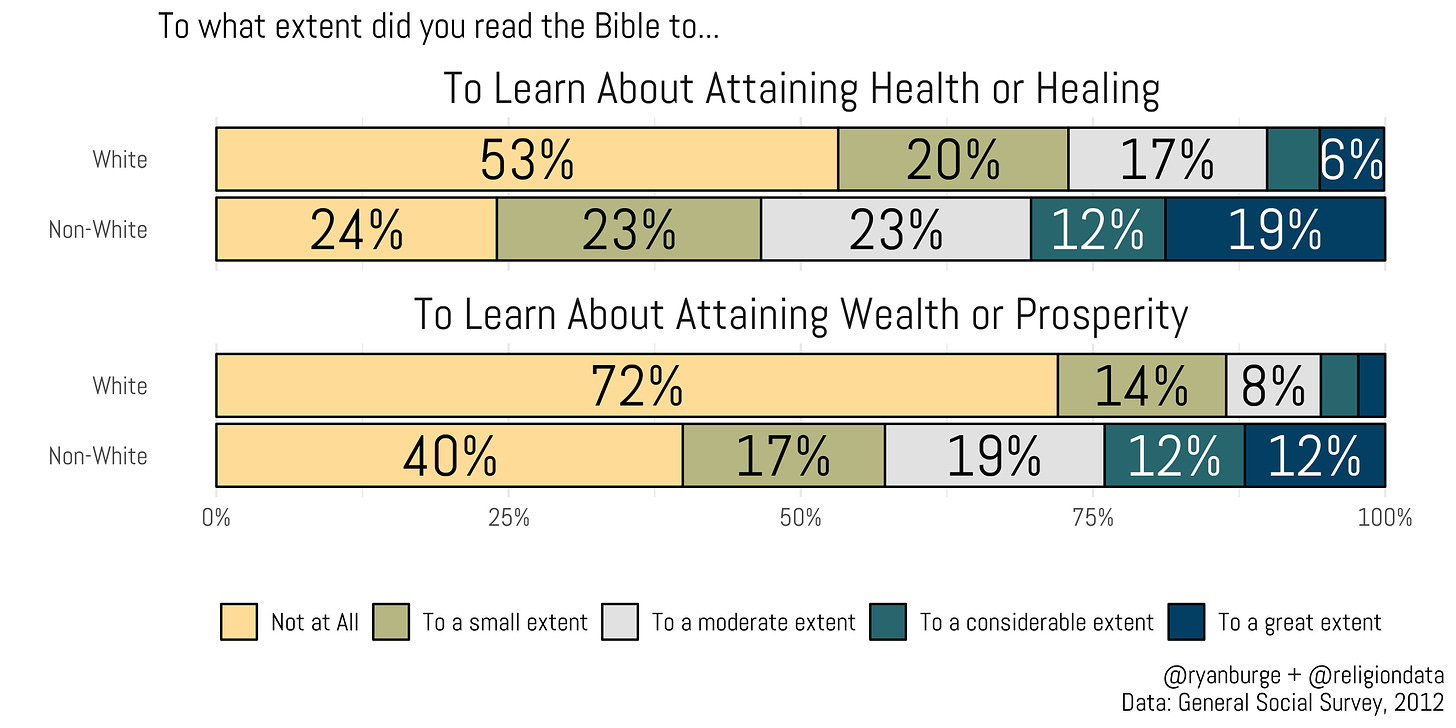
So if rich people aren’t using prosperity gospel to justify their wealth, then what are they doing? Well, aside from the ones who go atheist, and the ones who are part of some wealthy ethnic minority immigrant group (Jews, Hindus, …Orthodox Christians?) it appears that mainline Protestants, particularly the WASPy ones like Episcopalians (Anglicans), Congregationalists (UCC), and Presbyterians, are the wealthiest.
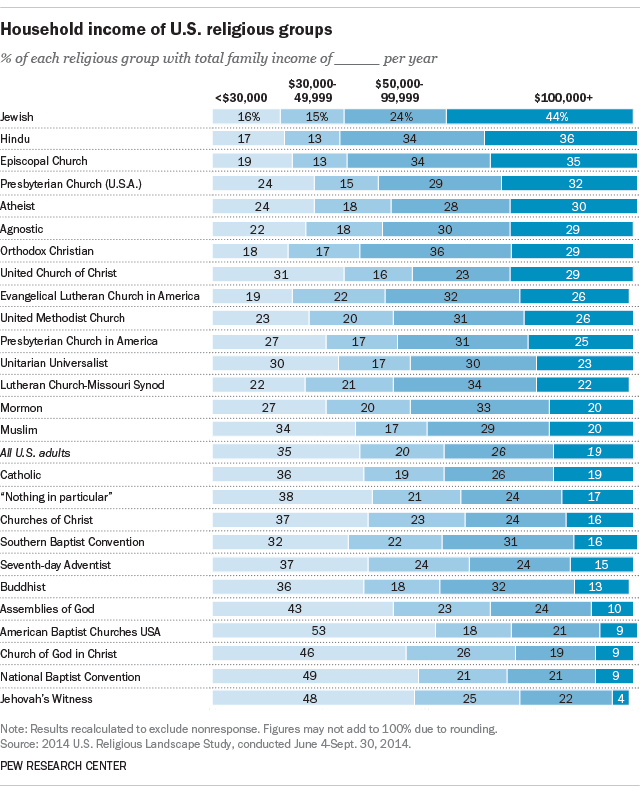
Again, this survey is from the early 2010s, it’s kind of old by now. Mainline Protestantism is in complete decline and has been for decades, losing a lot of membership to non-denominational Churches.

I don’t think that rich people are using these churches to justify their wealth, as a lot of them are actually rather liberal and critical of wealth. The PCUSA is much wealthier than the PCA, and the main difference is that the PCUSA is more progressive. It may be sort of the opposite, that people involved in these churches have historically been encouraged to act in a way conducive to building wealth. Yes, a certain way of thought known by a lot of people as the “Protestant Work Ethic”.
Now, I don’t actually believe that the Protestant work ethic is the reason why ultra-Protestant countries are very successful, or why mainline protestants are wealthy in the US, but I think it shares an original cause with the true reason. The heart of Protestantism, which predates Protestantism itself and is already present in Italian Humanism, is that the individual has a degree of pastoral and clerical responsibility. He is saved by his own faith, his own contemplation, and the custodianship of his own internal church, rather than merely by the external institutions. On one hand, this encouraged mass literacy in Protestant nations, and furthermore it meant that the literate population was not siphoned off by the Church. I believe this is he real reason for Protestant success, but it is related to the Protestant work ethic, because the other side of this new outlook was that every man was also a monk. Not entirely, as Luther (a former friar himself) and the other reformers were critical of a lot of the elements of Monastic life, but insofar as laymen were encouraged to act in a quasi-ascetic manner while continuing to participate in the human world around them (as opposed to monks and medicants, who were perceived as renouncing the social elements of compassion).
The first adopters of the “Protestant work ethic” were Catholic monks, in my opinion. In theory, they were meant to be a poor bunch, but by accident, the Monasteries grew to become some of the wealthiest institutions in Europe. When you’re constantly getting donations and second sons of nobles, have an army of lay brothers to work the fields, and don’t consume many luxuries on account of an ascetic twinge, you find yourself with a lot of profits. Of course, there was absolutely no shortage of medieval Monks who didn’t follow the ascetic principles in practice, and plenty of medieval writings attest to this, but certainly they were more restrained than the general population… Monastic profits went, to some extent, to charitable causes, but they also went towards the expansion and furnishing of the monastery. Not to mention, monks used their privileged to do practical research and experimentation that improved their productive output. By the time Henry VIII dissolved the monasteries of the British isles, at least one-fifth (and possibly over one-third) of inhabited land in England was owned by the Church. The monasteries had acquired such a great deal of land that often times their farms were worked mostly by peasants who worked the land as tenants, rather than monks themselves. Although this is the most famous instance of seizure of monastic lands, the same thing was happening all across Protestant countries.
Of particular interest to me are the Cistercians, who were founded as a reaction to the decadence of many medieval monasteries, which despite claiming to be founded upon the laws of St. Benedict failed to enforce them. Cistercian monks sought to return to a focus on their worldly work as a devotion to God, not just in a sense of working “hard”, in fact they outsourced farm-labor in a similar manner as other monks, but more in the sense of doing “good” work through the implementation of technology into their work, the creation of efficient labor and resource allocation systems, and the use of profits to purchase more land.
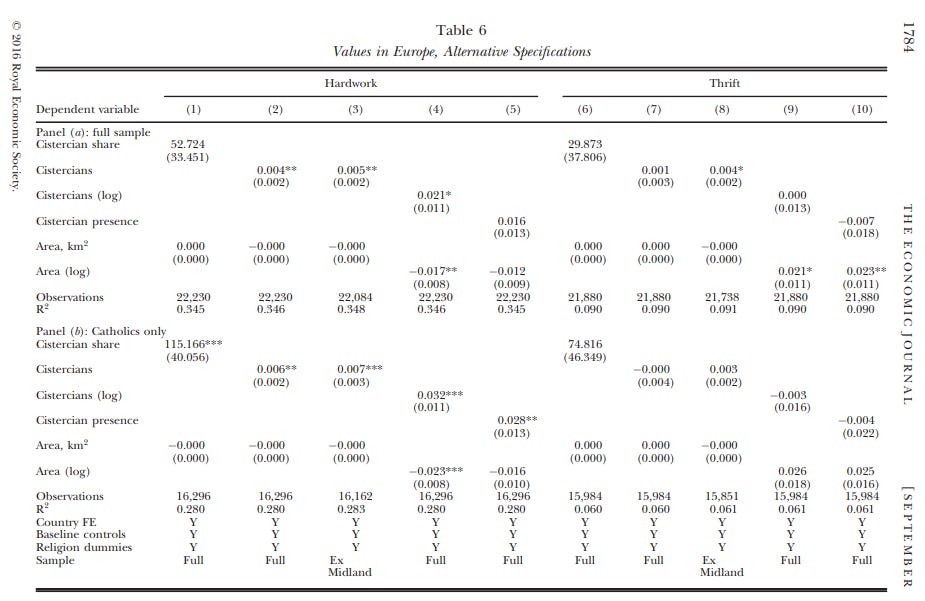
While much of Europe rejected the hermitic nature of the monasteries during the reformation, those areas which had housed Cistercians benefitted financially from their fruits and are still wealthier today. Even more interestingly, the Cistercian attitude towards work seems to have rubbed off on them. From Pre-Reformation Roots of the Protestant Work Ethic:
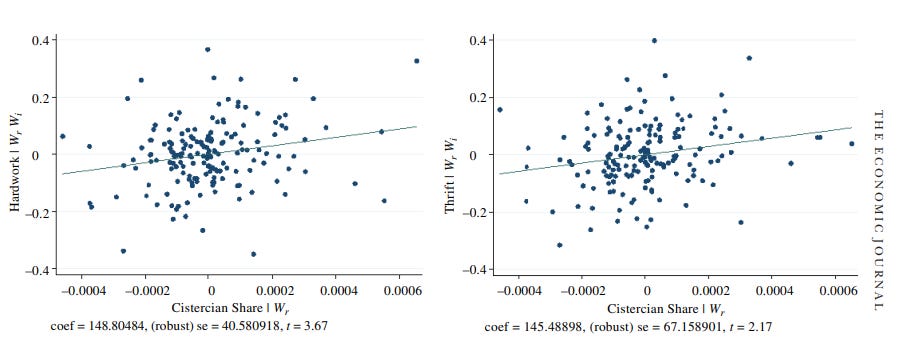
As can be seen from Table 6, the link between Cistercian presence and hard work appears rather robust. It is generally found, no matter how we measure the Cistercian influence, and in all sub-samples. In particular, in the non-Protestant sample every indicator carries significant explanatory power. These results are consistent with a Cistercian cultural impact in terms of work ethics across Europe in general as well as within England specifically. The latter results further support our interpretation of the significant impact from the Cistercians on population growth in England that we documented above. The results with regards to thrift are less strong, and only in one case do we obtain a significant partial correlation between Cistercian historical locations and thrift. Things change, however, when we aggregate to the NUTS2 level and examine the determinants of the fraction of respondents at the NUTS2 level valuing hard work and thrift (results are reported in online Appendix C, Table C9). For hard work we find results that are qualitatively similar to those pertaining to the individual-level: areas with greater Cistercian density harbour a larger fraction of respondents who find hard work to be a value worth passing on to their children. For thrift the results are now somewhat stronger. The partial correlation between Mc=M and the fraction of respondents who find thrift to be a value worth passing on to their children is positive and significant at conventional levels in all but one column. Figure 6 depicts the partial correlation between Cistercian density and hard work and thrift, respectively. It is clear that no particular region or group of regions seems to be driving the results in either case.
Not all Protestants were so opposed to monasticism. Most importantly, there were some who had positive things to say about its ascetic elements. Calvin, whose direct disciples and indirect successors in France, the Netherlands, and England are most strongly associated with the Protestant work ethic, had many positive things to say about ancient monasticism, but was critical of what it had developed into and viewed there to be an unpleasant kernel of misanthropy in the practice from the get-go. He says the following:
By this contrast between ancient and modern monasticism, I trust I have gained my object, which was to show that our cowled monks falsely pretend the example of the primitive Church in defence of their profession; since they differ no less from the monks of that period than apes do from men. Meanwhile I disguise not that even in that ancient form which Augustine commends, there was something which little pleases me. I admit that they were not superstitious in the external exercises of a more rigorous discipline, but I say that they were not without a degree of affectation and false zeal. It was a fine thing to cast away their substance, and free themselves from all worldly cares; but God sets more value on the pious management of a household, when the head of it, discarding all avarice, ambition, and other lusts of the flesh, makes it his purpose to serve God in some particular vocation. It is fine to philosophise in seclusion, far away from the intercourse of society; but it ill accords with Christian meekness for any one, as if in hatred of the human race, to fly to the wilderness and to solitude, and at the same time desert the duties which the Lord has especially commanded. Were we to grant that there was nothing worse in that profession, there is certainly no small evil in its having introduced a useless and perilous example into the Church.
—The Institutions of the Christian Religion, 4.13.16
The progression from Calvin’s ideal of the dispassionate management of a household, into the frugal management of a firm or commercial farm (which is what became of much of the old Monklands) is quite clear. A pious businessman devotes his money to making more money, and devotes that money to making more money. It shouldn’t be any surprise that Adam Smith was born from a Presbyterian family, as what he expressed explicitly was already the implicit justification for the speculators of the Dutch Golden Age. The wealthy man who had no chance of entering heaven was someone who hoarded his wealth, or spent it on vanity items. The pious man was someone who gave his money away to the needy, but even better than the pious man was the financier who invested his money in such a way that it would optimize the amount of wealth increased in the world, thereby alleviating poverty in the long-term, for this was an attempt at compassion that was not based on empty sentiments but on a rational rule that promised good outcomes if repeated enough times.
Make what you will of this, as there are many reasons to disagree with it. Maybe you think it is wrong on a matter of principle, because you don’t think venture capitalism actually increases wealth. Maybe you think it is wrong because, while it does increase wealth, it fails to abide by the preferential option for the poor (which is, for the record, a 20th century woketholic idea which meant something completely different at the time of Calvin). Maybe it just feels too much like Effective Altruism, and that gives you the heebie-jeebies. But, what it is not is an attempt to rehabilitate the vanity of the wealthy, or affirm the ownership of material wealth as a fulfilling end. No, it is the exact opposite of this, it is an encouragement of a relationship with money and labor that attempts to walk a middle-path, a non-attached participation in it. It affirms the acquisition of wealth as a lesser end, but not the ownership of it. There are really very few ultra-wealthy people in the world today who live anything like this, I think the closest example would probably be someone like Warren Buffet who choses to live well below his means (or at least, that’s how he is portrayed). Unsurprisingly, Buffet was raised Presbyterian…
Many non-Christians also — again, understandably — revile the Calvinist Work Ethic for being the ultimate expression of Christian life-denial. It is, from the outside, a choice to literally waste your life in order to demonstrate your faith in your own election for the world to come. It’s a philosophy borne of the opinion that life is “what you do when you’re waiting to die”… But, is it that historically unique? Hesiod is probably the most influential bard among the Greeks behind Homer (and, if he existed, Orpheus), and he’s pretty insistent that conscientious and skillful labor (that accumulates wealth) is the chief virtue one can engage in, because work is justice. It is what the gods have proscribed to humanity, and it assists in the cultivation of justice (divine order). Works and Days is basically an attempt by Hesiod to encourage his corrupt, treacherous, and lazy failson of a brother to choose “good strife”, that is, the productive struggle of labor and the competition between men on the grounds of production of goods and services, rather than “bad strife”, which is characterized by warfare, banditry, and the subverting of truth and justice for one’s own gain.
Hesiod lived in a Greece that suffered from much of the same problems that the North Sea area did during the reformation. The homeland was overcrowded, but there were plentiful opportunities for mercantile and colonial ventures across the sea. Devoted, intelligent, and frugal farmers and merchants were offered land and markets that they could optimize if they poured themselves into it and took the necessary risks, but those who did nothing would find their households dwindling generation by generation. At the end of the day, in both scenarios, mass colonization projects and an expansion into international markets was able to lower the pressure on the homeland, but it required a sort of people who were more interested in expanding their enterprise than in raiding. I think even the description of Homeric Greeks as pirates and raiders is a little bit misleading… With the exception of military enemies of the Greeks (ex: the Trojans and Cicones) the first instinct of the Greeks is to demand the free exchange of goods with their hosts. It is only when their hosts refuse this offer (ex: Polyphemus) that the Greeks become justified in violence and theft, because the refusal of a market is a violation of hospitality. This sentiment is also reflected hundreds of years later by Xenophon. Later European Capitalist powers used basically the same logic in their colonial ventures… Piracy from every European nation in the East Indes was justified as a response to tyrannical despots refusing markets to European merchants, or taxing them heavily. The European transition from fortified ports in Asia and Africa to full-fledged land empires was a consequence of European gains in productivity forcing their merchants to search for larger and broader markets while the local population caught up.
Hesiod’s advice of temperance, discipline, and devotion to work is repeated by later agrarians such as Xenophon in his Oeconomicus, and Cato the Elder in his Di Agri Cultura. At the end of the day, though, the Pagans still recognized the acquisition of wealth as a means to an end. It was just one of several ways to cultivate virtue, and other means took priority such as intellectual and athletic merit. For Calvinists, virtuous activity was the habit of the saved, but was not necessary for salvation and did nothing on its own to benefit the soul.
But I digress… My main point is that the Protestant Work Ethic reflects a Protestant attempt at rehabilitating the ascetic virtues of the monks who preceded them, and whose seized land and assets they often took over. It is the polar opposite of “prosperity gospel” and other modern charismatic Protestant idolizations of material wealth, and shouldn’t be considered the source of such ridiculous beliefs. The other encourages the state of being wealthy, but rejects the temporal actions conducive to attaining that state. Thanks for reading.
Great article. Finally, someone beyond one wonderful Polish right-winger finally talks about this issue.
The Protestant work ethic is a myth; it's better reframed as the Faustian work ethic because as you say the Catholic Monastic orders possessed it, none more so than the Jesuits. What I think is going on is simply the ethnic split between northern and southern Europeans, and the work ethic is best explained by climatic factors, as well as the rise to power of the urban middle classes in the 16th and 17th centuries. Presbyterians are notably austere and serious because they are/were Scottish, and what we call Catholic laziness is simply a Mediterranean climatic reality.
The same movement (but with very different cultural assumptions and results) in the middle eastern culture eventually led to the rise of Islam (the Puritans of the Magi) but the split was reversed, with the Monophysite and Jewish South along with Nestorian and Zorastarian East (whose own differences eventually led to the next split of Sunni and Shiite) violently confirming the ruptures of the three councils and breaking away from the Greek Orthodox North and converting en masse to Islam. It isn't a coincidence that the rule of the Protectorate in Cromwells England feels like Sharia law.